
Nobody signs up for scope creep. It arrives one small request at a time: an email asking for a “quick” change, a comment in a coordination call, a markup nobody logged. Each one is reasonable on its own. Together they are a budget problem.
The short answer: scope creep in outsourced drafting comes from undocumented requests, not from any single big change. Prevent it with a written scope of work that states what is excluded as well as included, a fixed number of revision rounds, a rule that changes need a signed change order, and a log that tracks every request against that count.
This page is for principals who manage outsourced drafting relationships. It covers what causes scope creep, what to put in the contract, and a revision log to copy.
What actually causes scope creep?
Not one big change. Stephen D. Caruso, an attorney writing for Bean, Kinney & Korman (August 2025), describes it as work expanding beyond “the four corners of the contract,” usually through informal channels: a conversation, an email about a “minor” adjustment, a verbal go-ahead. Each request is small. The pattern is what causes the damage.
A legal guide on scope-of-work clauses (ReviewMyContract, May 2026) frames the root cause the same way from the other direction: scope creep happens when a project’s deliverables expand without a matching increase in budget or schedule, often because the original scope was vague enough that different people filled the gaps with different assumptions.
For drafting specifically, the gaps are usually one of these:
- What counts as a revision was never defined.
- How many rounds are included was never stated.
- Who can request a change was never limited.
- Verbal requests were treated as authorization.
What should the scope of work say?
Two things, both from the sources above. State what is included, and state what is not.
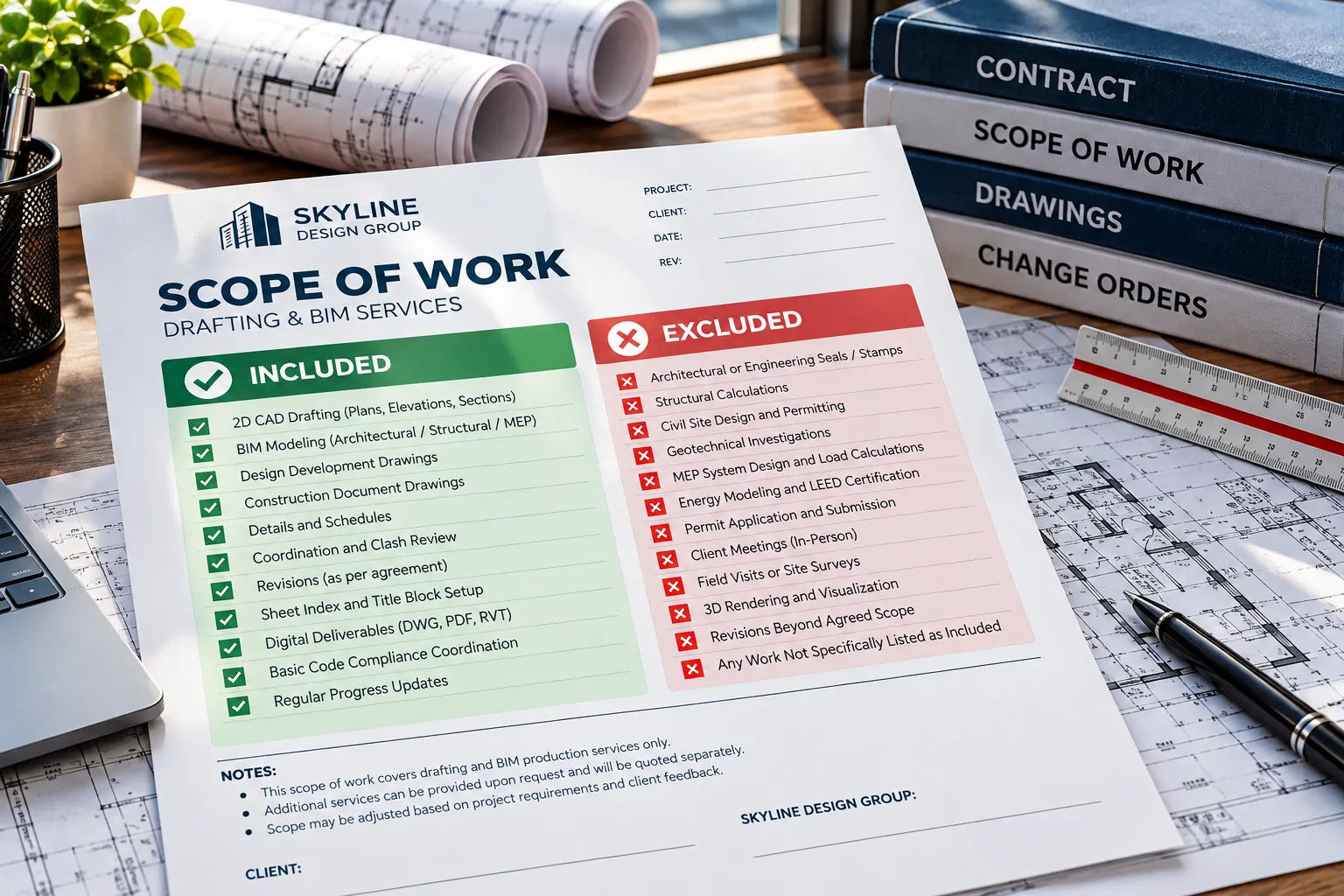
The ReviewMyContract guide recommends a statement of work that names the activities, deliverables and timeline, and explicitly states what is excluded. Exclusions do as much work as inclusions: “coordination with consultants beyond two rounds” or “code review” written as an exclusion closes a gap before it opens.
Example (illustrative). A drafting scope of work might read: Included: two rounds of drafter-side revisions per sheet set, based on markups received in one consolidated batch per round. Each round returned within [X] business days of receipt. Excluded: design changes to the approved layout; new sheets not in the original sheet list; consultant coordination beyond what is listed; code interpretation. These are available as additional services, quoted separately.
The wording is invented to show the shape. Your own scope should state your own numbers and your own excluded items.
How does a fixed number of revision rounds work?
It sets an expectation everyone can check against, not a hard stop on communication. A round is one consolidated batch of markups, reviewed and returned once. Two or three rounds is common in the sources above and in general practice, though the right number depends on the project.
What makes the limit work in practice:
- Markups are batched, not trickled in one at a time. A round starts when the batch is received.
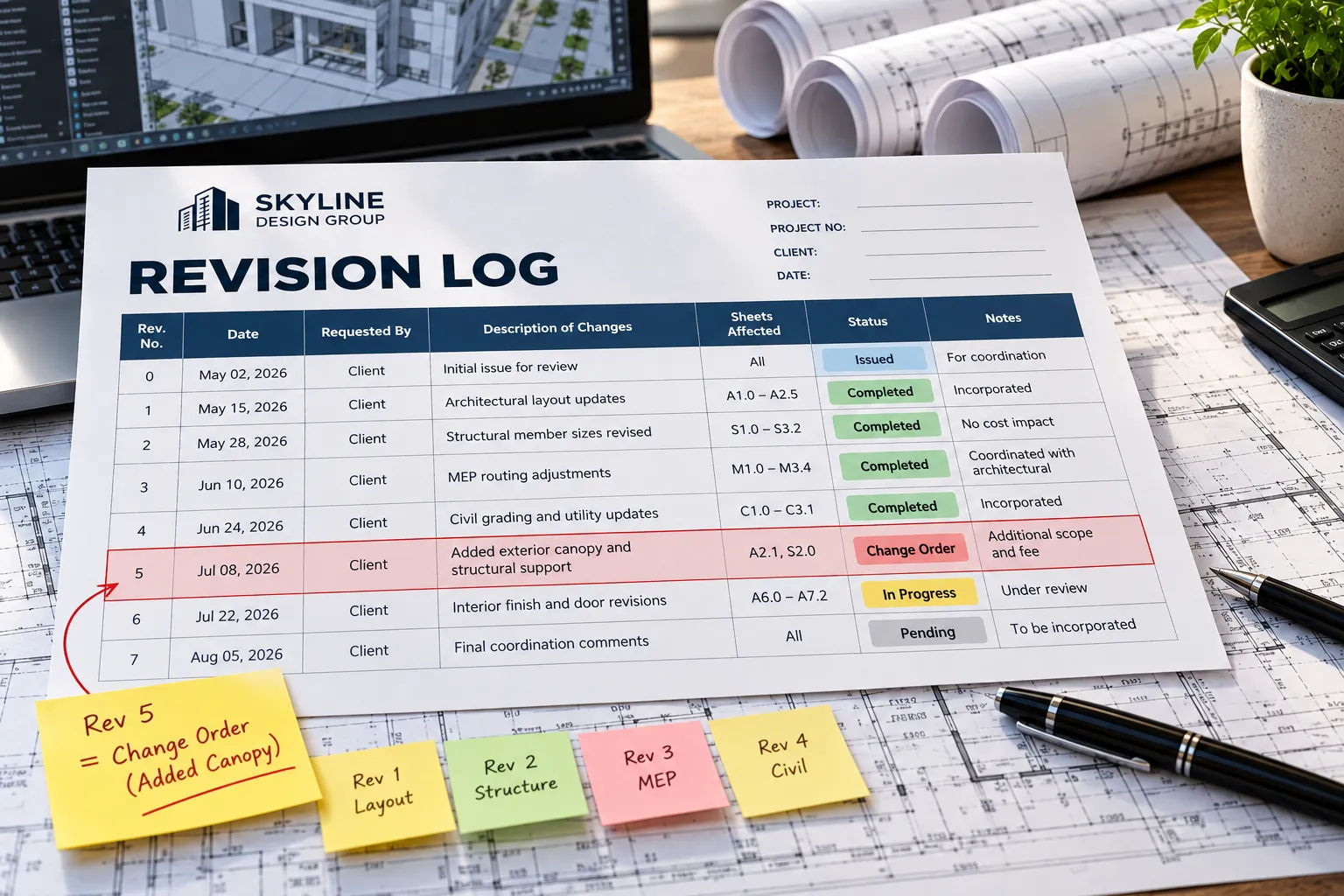
- Each round is logged, so both sides can see the count without an argument.
- The round beyond the included number is priced before it starts, not after.
- A round used for something outside the original scope (a design change, not a fix) counts as an additional service, not a revision round, whatever number it lands on.
That last point matters. A “revision” that changes the design is not the same thing as a “revision” that fixes a drafting error. Treating them the same is one of the more common ways a round count gets exhausted without anyone building anything wrong.
What does a change order need to include?
The ReviewMyContract guide is specific: a change order documents the change itself, the cost adjustment and the schedule adjustment, and both parties sign it. Caruso makes the same point from the construction side: verbal authorization alone creates exposure, and a written, signed change order is what protects both parties. He also recommends a change-order log recording the date, description, price and approval for every one.
For context on how a contract distinguishes what a drafting partner covers from what stays with the licensed architect, see who stamps the drawings. Reference AIA’s B101-2017, the standard owner-architect agreement, as one structured example of how a contract can separate categories of work. It distinguishes Basic Services from Supplemental Services (work identified as the architect’s responsibility when the agreement is signed) and Additional Services (work that may arise as the project proceeds and is compensated separately). The distinction, adapted to a drafting scope, is the same idea: name what is in from day one, and treat what arises later as its own line item.
What can go wrong even with a good contract?
The log is not kept. A contract with a revision limit and no log is a limit nobody can enforce, because nobody can prove the count.
“Quick” requests bypass the process. An email that says “just one small change” is still a request. Route it through the same log, however small it looks.
Design changes get counted as revisions. Watch for markups that change what the design shows, not just how it is drawn. Those belong outside the round count.
The scope of work has no exclusions. A list of what is included, with nothing said about what is not, leaves the gaps the ReviewMyContract guide describes. Write the exclusions down.
Change orders are approved after the work starts. By the time it is finished, there is no real price negotiation left. Price and approve first.
Write the scope before the markups start
If you want to see how a scope of work and revision structure work in practice, you can request a scope review: send one drawing set, your standards and a note on what you would keep in your own office. Skyline will work from a written scope, and revision terms are part of what gets agreed before work starts.
Sources
- Managing Scope Creep in Construction Projects, Stephen D. Caruso, Bean, Kinney & Korman, P.C. (August 27, 2025)
- What Is Scope Creep and When Does It Breach a Contract?, LegalClarity (May 13, 2026)
- Summary: B101-2017, Standard Form of Agreement Between Owner and Architect, AIA Contract Documents