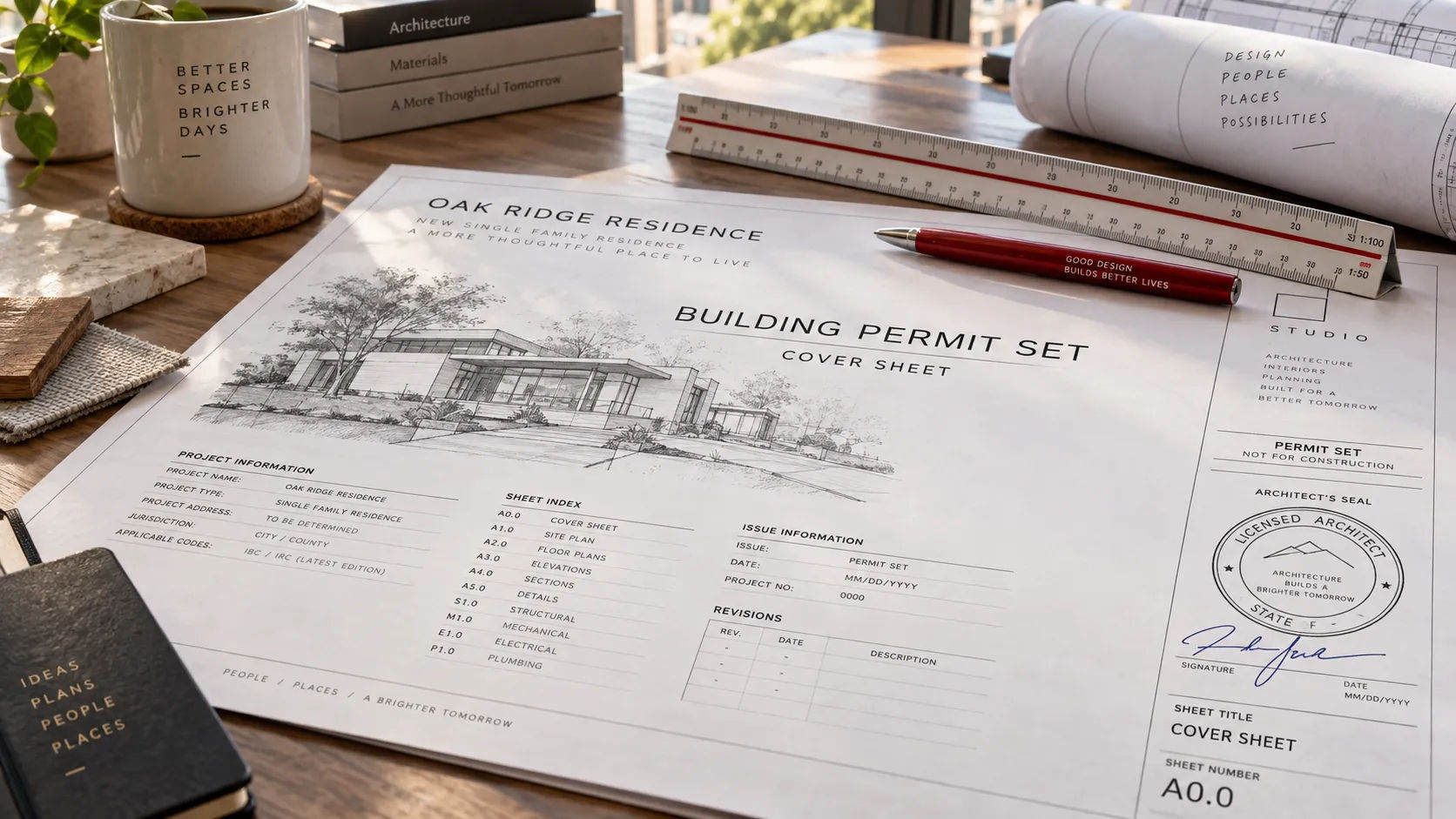
A seal is not a proofreading mark.
It does not say a licensed professional looked at the drawings. It says a licensed professional was in control of the work while it was made. That difference decides who can stamp a set, and it is why hiring a drafting partner does not move the responsibility off your desk.
The short answer: a drafting partner cannot stamp drawings. Only the licensed architect or engineer who held responsible control of the work can seal it, and reviewing drawings after they are finished generally does not count as control. A partner can produce drawings under your direction and should say plainly that seals, code review and permit sign-off stay with you.
This page is for principals and developers who are weighing outside drafting help and want to know exactly where the line sits. It is general information, not legal advice. State boards write their own rules, so check yours.
Who can stamp drawings?
The licensed professional who was in responsible control of the work. Not the person who drew it, and not whoever glances at it last.
The National Council of Architectural Registration Boards builds its Model Law and Model Regulations around that idea. Responsible control means ultimate authority over the design and technical decisions, plus the knowledge and ability to oversee, delegate and integrate them. Under the model, documents prepared by people working under an architect’s responsible control can carry that architect’s seal. The architect is also expected to keep records showing the nature and extent of the review and integration.
Engineers have the same principle under a different name. The NCEES Model Law names sealing documents that were not prepared by the licensee or under the licensee’s responsible charge among the grounds for disciplinary action. The National Society of Professional Engineers, in its position on responsible charge, says reviewing finished drawings, without taking part in developing them, does not meet the standard.
Insurance and risk advisors say the same in plainer language. One of them, Cavignac, warns that sealing work you did not control puts your license at risk, along with fines and personal liability, and that “plan stamping” as a pure revenue service is likely improper in many jurisdictions.
States adopt their own versions of these models, and the details differ. Your board’s rule is the one that applies.
What can a drafting partner do, and what can’t it do?
A drafting partner produces drawings. It does not make the decisions the seal stands behind. Skyline’s professional services disclaimer draws the same line, and the table below follows it.
| Activity | Drafting partner? | Who carries it |
|---|---|---|
| Producing plans, sections, details and schedules to your standards | Yes | You direct it, they draw it |
| Cross-sheet checks: tags, dimensions, references, revision data | Yes | Partner checks; you review at milestones |
| Updating sheets after you answer permit comments | Yes | You answer each comment; they revise |
| Flagging conflicts between architectural and consultant backgrounds | Yes | You decide who changes what |
| Professional seals and stamps | No | The licensed architect or engineer of record |
| Code compliance review and life-safety determinations | No | Architect or engineer of record |
| Engineering calculations and load verification | No | Licensed engineer |
| Survey or topographic certification | No | Licensed surveyor |
| Permit authorization and jurisdictional sign-off | No | The building department |
| Final design decisions | No | You |
Skyline’s disclaimer describes its deliverables as “production support data only.” It adds that a client who uses unsealed drafting documents for fabrication, construction or permitting, without review and approval by a properly licensed professional in the jurisdiction, assumes the liability.

What does “permit-ready” actually mean?
Prepared, not approved.
Skyline’s permit-ready packaging page defines it: the package is prepared for review by the architect or engineer of record, who remains responsible for design decisions, code determinations and professional sealing where required. The same page says Skyline does not stamp or seal drawings, and that it can help with comment logs, sheet revisions and resubmittal once plan-check comments arrive.
Read any vendor’s use of the phrase the same way. If “permit-ready” ever sounds like “approved,” ask what it means. A set can be ready to go to your review and still be nowhere near ready for the counter.
Example (illustrative). An invented scenario, not a client project. A developer’s team receives a “permit-ready” set from a drafting partner and takes it straight to the building department. The reviewer asks for the architect of record’s seal and signature. There are none. The set goes back, the schedule slips, and someone has to find a licensed professional who will take responsibility for drawings they did not control. That is expensive, and on some projects impossible. The fix was cheap and early: name the architect of record at the start and put them in control of the work.
What does responsible control look like in practice?
Rules differ by state, so treat this as a working habit, not a legal standard. The idea is simple: make the decisions before the drawing, review during it, and keep records.
- Set the scope and standards in writing before drafting starts. What sheets, which standards, which decisions stay with you.
- Make the design and code decisions yourself. Answer permit comments, egress questions and assembly choices before they reach the drafter.
- Review at milestones, not only at the end. The point is to be involved while the work is made.
- Keep records. The NCARB model expects documentation of the nature and extent of your review.
- Ask your board and your insurer. Some have specific expectations for work prepared by outside teams.
- Seal only what you can stand behind.
What can go wrong?
Several things, and they are mostly about control, not about where the drawing hours happen.
- Review at the end only. A set that is checked once, after it is done, may not qualify as controlled work at all.
- Decisions made by default. When a markup is unclear, the drafter guesses, and a guess becomes a design decision no licensed person made. A partner that flags instead of assuming, as Skyline’s redline process says it does, gives you a chance to make the call.
- Blurry contracts. If the agreement does not say who carries what, the seal decides. The seal is yours.
- State variation. What one board accepts, another may not.
- Insurance gaps. Ask your insurer before you commit. And the twelve questions to ask a drafting partner covers what to ask the partner.
None of this makes outsourcing unwise. Outsourcing production is not the problem. Handing off decisions is. The outsourcing hub shows where the split usually falls.
Keep the seal where it belongs
If you want to see how a partner works within those limits, you can request a scope review: send one drawing set, your standards and a note on what you would keep in your own office. Skyline drafts to your standards and leaves design decisions, code determinations and seals with your licensed team. For how the split works with a white-label arrangement, see white-label drafting.
Sources
- NCARB Model Law and Model Regulations, National Council of Architectural Registration Boards (responsible control; sealing and review records)
- NCEES Model Law, January 2024, National Council of Examiners for Engineering and Surveying (responsible charge; sealing documents prepared under it)
- Responsible Charge, National Society of Professional Engineers (adopted January 2017; revised May 2024)
- Signing, Stamping and Sealing Others’ Designs, Cavignac (published 2021, updated 2023)
- Skyline Design Group: professional services disclaimer, permit-ready packaging and redline conversions. Checked 2026-09-21.

