Who actually designs a steel connection isn’t a gray area — AISC’s Code of Standard Practice names three specific options, and only one of them involves the kind of engineering judgment that crosses from detailing into delegated design. Knowing which option a project is using changes what a detail package should contain and who has to sign off on it.
AISC 303-22 defines three connection-design options: the engineer of record provides complete designs (Option 1); a detailer selects connections from reference tables without engineering judgment (Option 2); or a licensed fabricator-employed engineer performs delegated design with calculations submitted for approval (Option 3). Option 2 is detailing. Option 3 is delegated design, requiring a licensed engineer because it involves engineering analysis.
Who this is for
This is for structural engineers scoping a steel connection detail package who need a precise answer to where detailing stops and delegated design begins — and what that means for who’s allowed to produce which part of the package.
AISC’s three options, in plain terms

AISC’s 2022 Code of Standard Practice (ANSI/AISC 303-22) lays out three ways connection design responsibility can be assigned, decided by the engineer of record (called the Owner’s Designated Representative for Design, or ODRD, in the code):
| Option | Who designs the connection | What’s required |
|---|---|---|
| Option 1 | Engineer of record | Complete connection designs shown in the structural design documents |
| Option 2 | Experienced steel detailer | Selects/completes connections using reference tables (e.g., AISC Manual tables) — no engineering judgment required |
| Option 3 | Licensed engineer employed by the fabricator | Delegated design with substantiating information submitted to the engineer of record for approval |
The code is specific that Option 2 is not a backdoor into engineering work: it states plainly that “it is not the intent that this method be used when the practice of engineering is required.” The moment a connection needs actual engineering analysis — not just table lookup — it moves into Option 3 territory and needs a licensed engineer, not a detailer [CLIENT TO CONFIRM — confirm which option the project’s contract documents specify; this determines what Skyline can and cannot produce for a given connection].
What delegated design actually requires from the engineer of record
A connection designer can’t produce a sound delegated design from vague information, and a STRUCTURE magazine piece by a P.E./S.E./DBIA-credentialed author is specific about what the engineer of record owes the process: project-specific details showing the “conceptual configuration for the order of magnitude of the forces,” accurate reactions for each beam rather than conservative blanket estimates, loads separated by type (dead, live, wind, seismic) so code-compliant reductions can be applied, and clear specifications on connection restrictions and material grades. The same source notes this information has to be sufficient for accurate bidding — fabricators shouldn’t need to hire an engineer just to put together a proposal [CLIENT TO CONFIRM — this reflects one author’s professional guidance, not a universal requirement; confirm expectations against the specific project’s contract documents].
Where detailing fits and where it stops
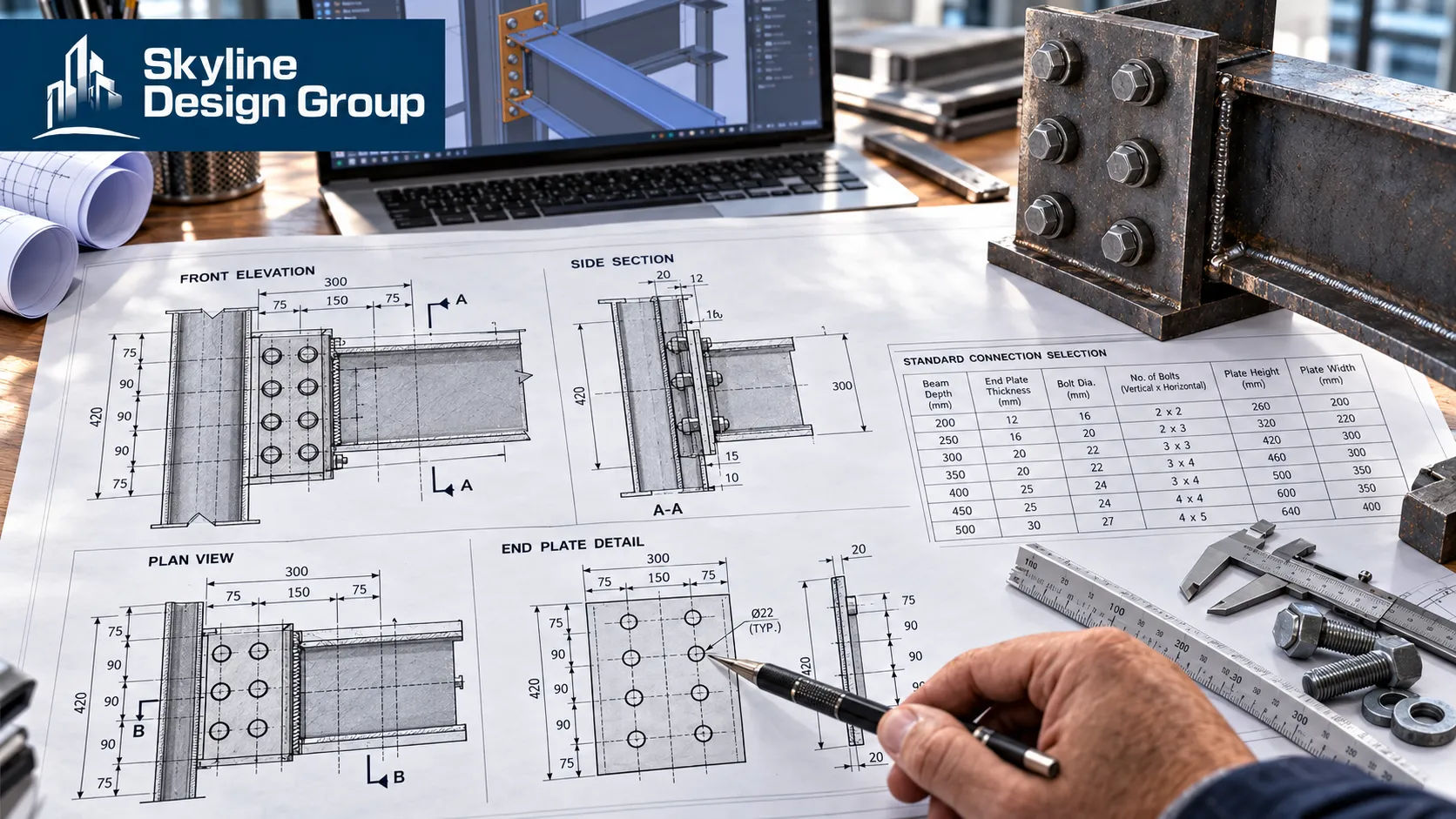
Skyline’s drafting work fits squarely within Option 2 — detailing connections to standard configurations and reference tables the engineer of record specifies, without performing engineering analysis. When a connection requires actual design judgment — a non-standard condition, a load case outside standard table coverage, anything that crosses from “select from a table” into “calculate and justify” — that’s Option 3 territory, and it stays with a licensed connection engineer, whether that’s the engineer of record directly or a delegated engineer employed by the fabricator [CLIENT TO CONFIRM — confirm this scope boundary matches Skyline’s current service agreement; Skyline does not perform structural engineering analysis or stamp connection designs].
The same STRUCTURE magazine source flags a recurring problem at this exact boundary: confusion about whether a connection engineer should seal shop drawings creates liability exposure for everyone involved. Knowing in advance which option governs a given connection avoids that confusion before it becomes a signature dispute late in the project.
Why this distinction shows up in RFI counts later
A detail package built on the wrong assumption about which option governs a connection tends to surface as an RFI during fabrication or erection, not during design review — because that’s when someone actually tries to build the connection as drawn and finds it doesn’t hold up under the real load case. A connection detailed under Option 2 that actually needed Option 3 engineering judgment is a common version of this: the detail looks complete on paper, references a standard table, and still gets kicked back once a fabricator’s engineer or the engineer of record reviews it against the actual forces involved.
Getting the option right at the start of a detailing engagement — before any sheets are drawn — is cheaper than resolving it through an RFI cycle once steel is being fabricated. This is one of the reasons a detail package benefits from an explicit statement, sheet by sheet, of which AISC option each connection was detailed under, so a reviewer doesn’t have to guess which standard applies. See structural shop drawing submittals and cutting the RFI count for how that documentation habit connects to broader submittal RFI reduction.
If you need steel connection details produced to Option 2 reference-table configurations the engineer of record has specified, Request a Scope Review — send the current design documents and get back a specific read on what Skyline can detail directly.