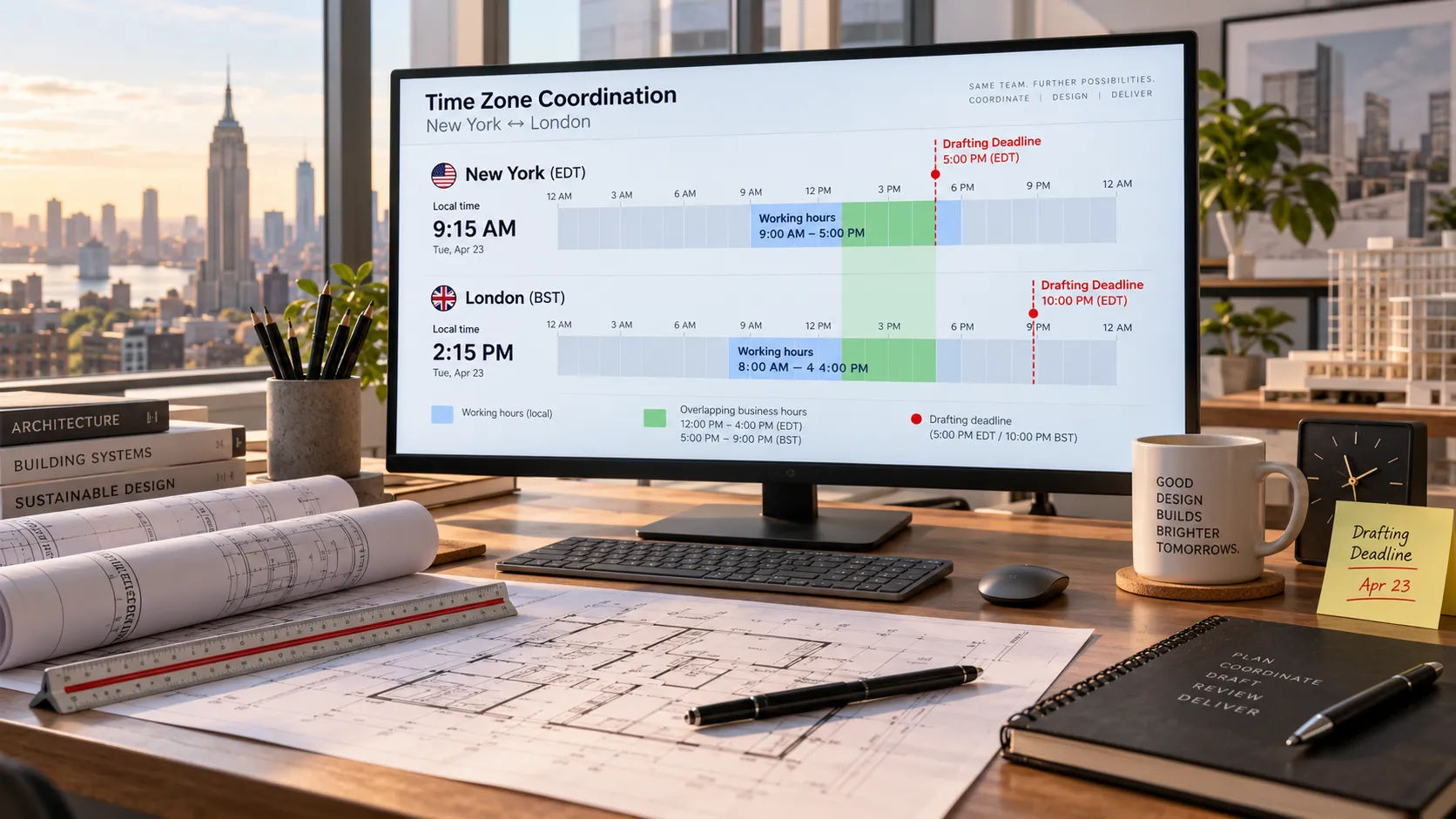
“Overnight turnaround” sounds like a single promise. It is actually five or six separate questions, and a vendor who answers only the flattering one has told you less than it sounds like.
The short answer: a turnaround SLA should define response time, production time, what counts as a business day in each time zone, how revisions are scheduled, what happens if a deadline is missed, and how urgent work is escalated. Get each in writing, specific to your project, rather than accepting “overnight” alone.
This page is for principals evaluating a drafting partner’s turnaround claims, especially where time zones are part of the pitch. It covers what a real SLA defines, what a time zone actually buys you, and a checklist to take into a vendor conversation (the twelve questions to ask a drafting partner touches turnaround too). Skyline has not published turnaround figures on its site; where this page mentions Skyline, it says so.
What does “overnight turnaround” actually claim?
At minimum, that work sent at the end of one business day comes back before the next one starts. What it does not automatically tell you:
- Whether “overnight” means calendar hours or business hours, and in whose time zone.
- Whether it applies to first drafts, revisions, or both.
- What size or complexity of request qualifies. A single-sheet redline and a 40-sheet set are not the same overnight.
- What happens if the work is late. Nothing, usually, unless the agreement says otherwise.
None of that makes “overnight” a false claim. It makes it an incomplete one until the rest is defined.
What should a turnaround SLA actually define?
IBM’s overview of service level agreements lists the core pieces any SLA should cover: the performance metrics being promised (response and resolution timeframes among them), how those metrics are measured, what happens when the target is missed (service credits, escalation, or another remedy), and a set schedule for reviewing and updating the terms. Applied to drafting work, that becomes six concrete questions.
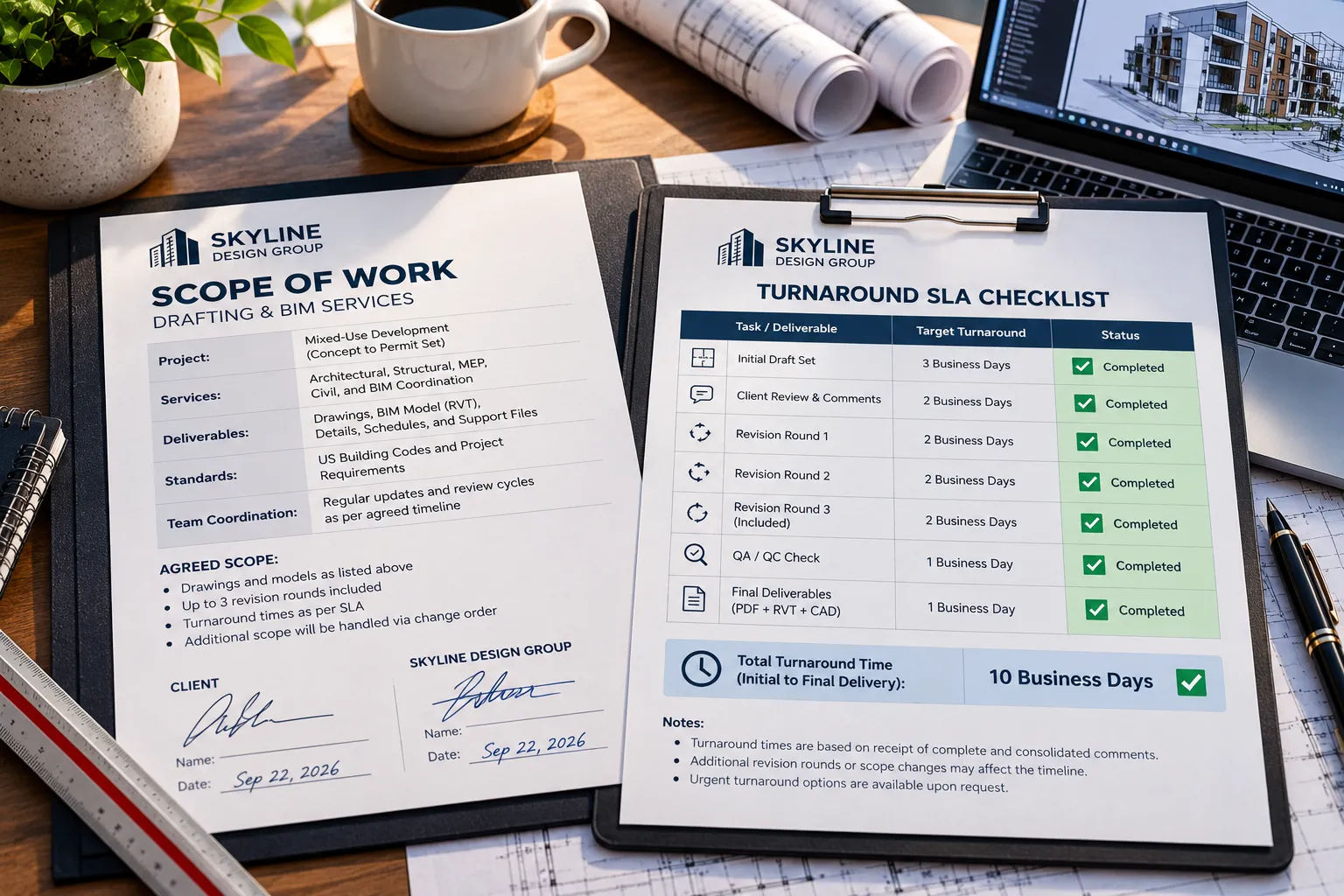
| Term | What to ask | Why it matters |
|---|---|---|
| Response time | How long before someone confirms receipt and gives an estimate? | Silence after sending a set is the first sign of a problem |
| Production time | How long from confirmed receipt to delivery, by request size? | “Overnight” needs a size threshold to mean anything |
| Business day definition | Whose calendar and time zone counts as a business day? | A 6pm submission may or may not start a partner’s clock the same day |
| Revision turnaround | Does the same SLA apply to revisions, or a different one? | Revisions are often treated differently and rarely are by default |
| Missed-deadline remedy | What happens if the promised time is missed? | IBM’s framework calls this the redressing section; without it, there is no consequence to a miss |
| Escalation path | Who do you contact, and how fast, for a true rush? | A named contact beats a general inbox when a deadline is close |
What does a time zone actually buy you?
A window of hours when someone else is working while your office is not. Nothing more, nothing less. Two structures come up in general practice.
A single overlap window. Your afternoon overlaps with the partner’s morning (or the reverse). Work handed off in that window gets a partial day’s head start.
A follow-the-sun handoff. Work moves from one time zone’s business hours into another’s as the first ends, so the project keeps moving close to around the clock. A 2023 piece on managing time zone differences in outsourcing (updated September 2026) describes this as multiple teams handing off during overlapping hours, using shared documentation so the incoming team does not have to wait for a live conversation to pick up the work.
The second structure needs more than a time difference to work. The same piece stresses two things that make a handoff actually work: clear, complete written requirements so the next team does not need a synchronous conversation to proceed, and shared documentation platforms rather than email threads that only one side can see. A time zone gap without those is just a delay with a friendlier name.

What do published turnaround claims from vendors actually look like?
For comparison, not for Skyline pricing. Tejjy, a drafting vendor, publishes turnaround ranges rather than a flat “overnight” promise: a single-tenant retail fit-out at 5 to 10 business days, a full commercial permit set at 2 to 6 weeks. No price is attached. That is the shape a credible turnaround commitment takes: a range, tied to a defined scope, not a single word applied to every request. The cost guide covers the same idea for pricing units.
What can go wrong with turnaround claims?
“Overnight” with no size or scope attached. Ask what request size the claim actually covers.
A time zone story with no shared documentation. Coverage across hours does not help if the incoming team has to wait for a live call to understand the work.
No remedy for a miss. IBM’s SLA framework treats this as a required section, not optional. If a missed deadline has no consequence in writing, it has none in practice either.
Revisions assumed to be as fast as first drafts. Ask directly; do not assume the same SLA applies.
A rush request with no named path. When something is actually urgent, a general inbox is not an escalation path.
Get your own turnaround terms in writing
If you want turnaround terms specific to your project rather than a general claim, you can request a scope review: send one drawing set, your standards and a note on what you would keep in your own office, and ask for the six terms in the table above in writing. See the outsourcing guide for the wider decision of what to hand off.
Sources
- What Is an SLA (service level agreement)?, IBM (published May 30, 2024)
- How To Handle Time Zone Differences For Offshore Outsourcing, Thuy Doan (June 14, 2023; updated September 17, 2026)
- Tejjy turnaround ranges, read as part of this series’ vendor research (checked September 2026)
- Skyline Design Group’s service pages, checked 2026-09-21, for confirmation that no turnaround figures are published.