Resolving MEP Clashes Without Blowing the Coordination Schedule
The fear with MEP coordination is never that it won’t find clashes. It will — that’s the point. The fear is that finding them turns into an open-ended loop: a meeting surfaces forty conflicts, nobody owns the follow-up, and three weeks later half of them are still open while the schedule that assumed coordination would be done by now keeps moving anyway.
Clash resolution does not have to cost schedule. It costs schedule when it has no cadence, no ownership and no deadline attached to each item — not because finding conflicts takes time on its own.
Resolving MEP clashes without losing schedule time means running coordination on a fixed weekly cadence, assigning every clash to a named person with a date, following up mid-week instead of waiting for the next meeting, and never canceling a session outright. The clashes themselves rarely cause the delay — an undefined follow-up process does.
Who this is for
VDC managers running the coordination process on a multifamily, commercial or mixed-use project, where the coordination schedule is tracked against real milestones like a fabrication release or a rough-in start date.

Why does clash resolution slip in the first place?
It is rarely the clash test itself. Running a clash test takes minutes. What takes time is everything after: deciding who owns a fix, deciding how, updating the model, and confirming the fix actually worked. Without a defined process for that sequence, open clashes accumulate meeting over meeting, because nobody set a deadline on any of them specifically.
A documented coordination-meeting framework used by a major U.S. general contractor states this plainly as a set of habits, not a software feature: hold the meeting at a fixed weekly day and time, review markups and assign responsibility during the meeting itself, and — critically — follow up mid-week rather than waiting until the next session to find out if something got resolved.
What does a cadence that actually holds look like?
- A fixed weekly meeting day and time. Not “as scheduling allows.” A standing slot that the whole coordination team can plan around.
- Every clash assigned to a named person, in the meeting, with a date. Not a general note that “mechanical will look at it.”
- A mid-week check, not a wait until the next meeting to discover whether an item got closed. This is the step most teams skip, and it is the one the GC framework calls out directly as the difference between staying on schedule and finding out too late.
- Meetings that do not get canceled. If the lead cannot attend, a named backup runs it. Skipping a session does not pause the clock on whatever milestone the coordination schedule is tracking toward.
- A visible tie to the real deadline — a fabrication release date, a rough-in start, a permit submission — so “resolve this clash” is understood as “resolve this before the date that actually matters,” not an open-ended task.
How should clashes get prioritized so the real ones get attention first?
Not every clash deserves the same urgency. Sorting by severity before assigning owners keeps the team from spending a meeting on duplicates or minor clearance issues while a hard clash blocking a critical path sits untouched.
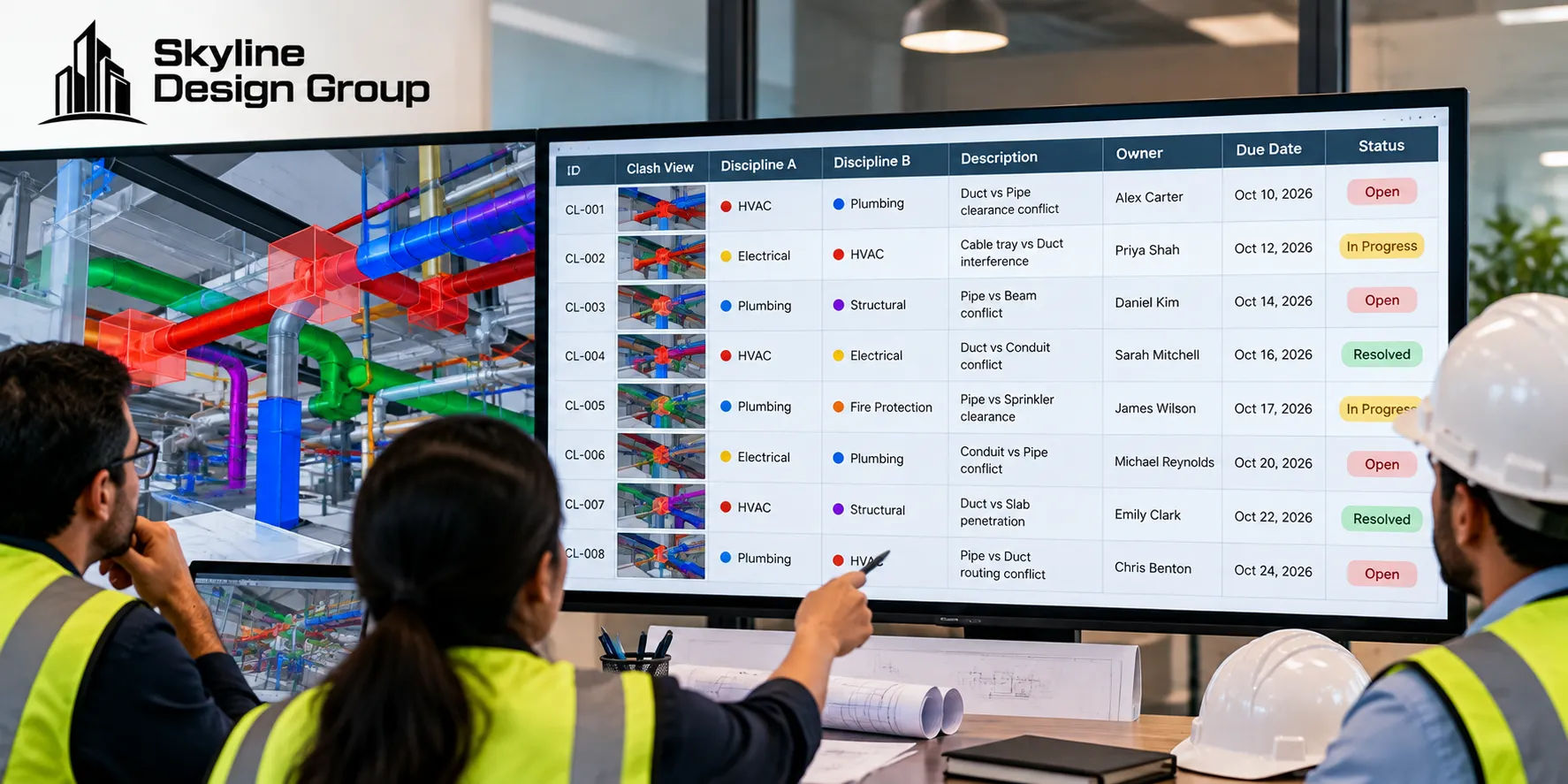
Example (illustrative) weekly clash resolution tracker:
| Clash ID | Severity | Assigned to | Due | Status |
|---|---|---|---|---|
| C-021 | Hard | Mechanical | This Wed | Open |
| C-022 | Clearance | Electrical | Next meeting | Open |
| C-023 | Hard | Plumbing | This Wed | Resolved |
| C-024 | Duplicate | _ | _ | Closed, no action |
Hard clashes with a near-term deadline get the mid-week follow-up first. Clearance issues with more schedule slack can wait for the next regular session without putting anything at risk.
What happens when a team skips the follow-up step?
The honest version: nothing happens immediately, which is exactly the problem. A clash that is “assigned” but never checked mid-week can sit open for a full week without anyone noticing, because the next data point on it is the following meeting. On a tight coordination schedule, one missed week on a hard clash can be the difference between a model that is ready for its planned release date and one that isn’t — and that slip usually doesn’t surface until the release date itself.
Canceled meetings compound the same problem faster. The GC framework above calls this out directly: coordination meetings should not get canceled, and a named backup should run the session if the usual lead is unavailable. Skipping a week does not pause whatever deadline the coordination schedule is tracking toward — it just means two weeks of clashes get reviewed in the time that was supposed to cover one, with less time left to resolve what the test finds before the real milestone.
What does “on schedule” actually mean for a coordination phase?
It helps to separate two different schedules that often get confused. There is the coordination meeting schedule (weekly, biweekly, whatever cadence is set) and the project milestone schedule (fabrication release, rough-in start, permit submission). Coordination is on schedule when the second one holds, not just when meetings happen on time. A team can run every meeting on the dot and still miss the real deadline if clashes aren’t actually closing fast enough relative to it. Tracking both — meeting cadence and milestone countdown — side by side is what keeps “we’re coordinating” from quietly becoming “we’re behind and didn’t notice yet.”
Where this fits into a coordination partner’s scope
If your coordination meetings are finding clashes but the open list keeps growing anyway, Request a Scope Review — send your current clash log and a note on where the follow-up tends to break down.
For the overall coordination process this cadence supports, see MEP modeling and coordination explained. For how isometrics and spool numbers factor into field-side clash fallout, see MEP isometrics explained. For the design-versus-coordination line that governs who can actually approve a clash fix, see MEP coordination vs MEP design.