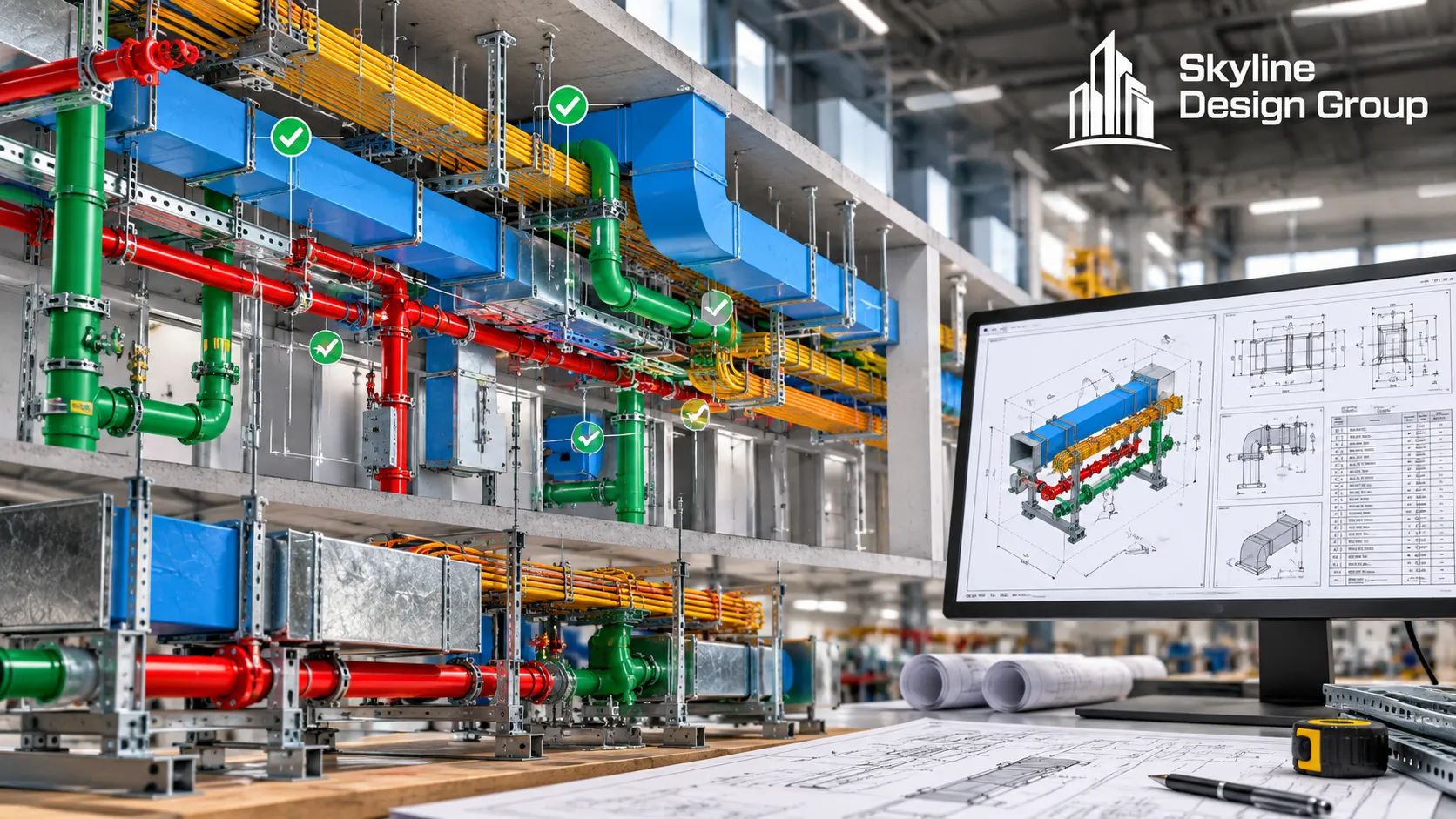
7 Things a Prefabrication-Ready MEP Model Needs Before It Goes to the Shop
A model can pass every clash test in the coordination tool and still be useless to a fab shop. Clash-free is not the same as fabrication-ready. A VDC manager who sends a coordinated-but-not-detailed model to the shop usually finds that out the same way: a spool comes back missing a hanger location, or the shop calls asking what the insulation spec was supposed to be.
Fabrication readiness is a specific, checkable state, not a vague sense that “the model looks done.” Here is what actually has to be true before a model goes to the shop.
A fabrication-ready MEP model has spec, insulation, hangers and supports modeled (not left for the shop to guess), an accurate bill of materials generated directly from it, automated spool drawings and shop tickets, clear sign-off on who approves it, a defined revision protocol, and field conditions confirmed rather than assumed. Clash-free coordination is a prerequisite, not a substitute for this.
Who this is for
VDC managers and GC project executives deciding whether a coordinated model is actually ready to hand to a mechanical, electrical or plumbing fab shop, and production partners building models that need to survive that handoff.
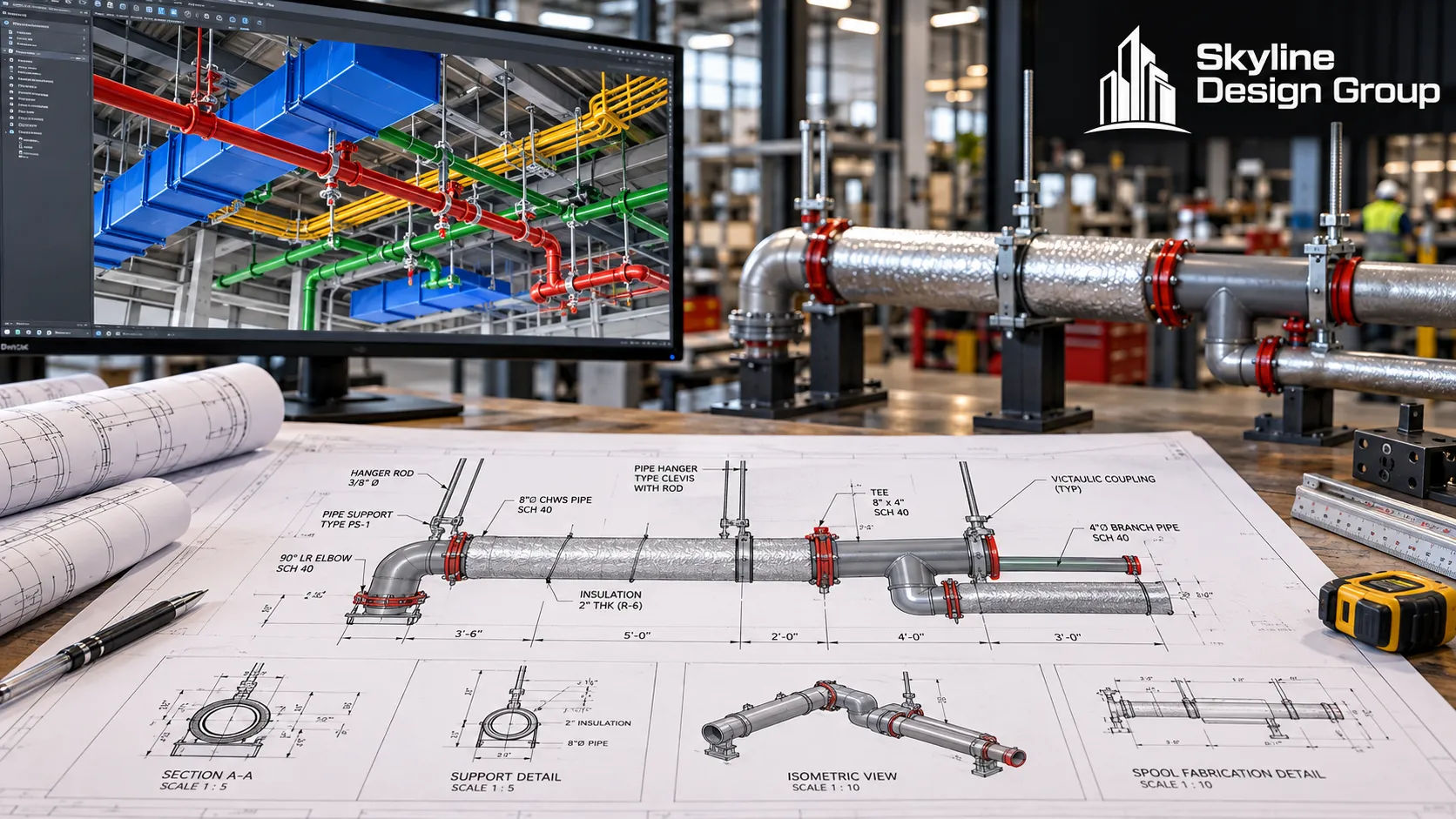
1. Fabrication-level detail, not just coordination-level detail
A model built to the level needed for clash detection (BIM Forum’s LOD 350, built for coordination specifically) is not automatically built to the level a shop needs to fabricate from. BIM Forum’s Level of Development Specification places true fabrication detail at LOD 400 — the level where a component’s actual size, shape, location, quantity and orientation are modeled with fabrication, assembly and installation detail, not just enough to check for clashes. An MEP vendor checklist on BIM-to-fab-to-field readiness states it plainly: verify that spec, insulation, hangers and support data are modeled, not left for the shop to guess.
2. A clash-free model behind it, not instead of it
Fabrication-ready assumes coordination already happened. A model that goes straight from design to fab without a clash pass just moves the same conflicts into cut pipe and formed duct, which costs far more to fix than a model update. Confirm the coordination sign-off happened and the clash log is closed before sending anything to the shop.
3. An accurate bill of materials generated directly from the model
The BOM the shop orders against should come from the same model as the spool drawings, not a separately re-typed list. Manual BOM re-entry is where over-ordering and under-ordering both start, because the two sources drift the moment either one gets a late change.
4. Automated spool drawings and shop tickets, not hand-redrawn ones
Spool drawings and shop tickets should generate directly from the model’s current state. Every manual step where someone redraws or retypes what the model already shows is a chance for the shop’s copy to diverge from the latest revision.
5. Clear ownership of the fabrication-ready call
Someone specific has to approve that a package is fabrication-ready, and someone specific at the shop has to confirm it was received in that state. Without a named owner on each side, “fabrication-ready” becomes a guess rather than a checkpoint.

6. A revision protocol that actually reaches the shop floor
Models change after the first fabrication-ready package goes out — almost always. What matters is whether there is a defined way for that change to reach the shop before cutting starts on the old version. A revision protocol with no enforcement is the same as not having one.
7. Field conditions confirmed, not assumed
On a renovation, tenant improvement or any project touching existing construction, a model is only as fabrication-ready as the field data behind it. If the model assumes a ceiling height, a structural clearance or an existing utility location that was never field-verified, the fabricated spool may not fit the actual space. Confirm field dimensions before fabrication on anything built around existing conditions.
Example (illustrative) fabrication-readiness sign-off, the kind of short form a shop should see attached to every package:
          PACKAGE: Level 3 Corridor Mechanical Spools, Run A
          LOD CONFIRMED: 400 (spec, insulation, hangers, supports modeled)
          CLASH LOG: Closed, 0 open items
          BOM SOURCE: Generated from model rev 14, same date as spool set
          APPROVED BY: [Name], VDC Manager — 2026-10-07
          SHOP RECEIPT CONFIRMED BY: [Name], Fab Shop — 2026-10-08
What happens when a model skips one of these
The honest answer: it depends on which one gets skipped, but the pattern is consistent. Skip fabrication-level detail and the shop fills in gaps with assumptions. Skip the BOM-from-model rule and ordering drifts from what actually gets installed. Skip field verification on a renovation and a spool arrives that does not fit. None of these show up as a clash in the coordination tool — they show up as a problem at the shop or on site, after the cost of fixing it has gone up.
Where this fits into a production partner’s scope
[CLIENT TO CONFIRM] whether Skyline’s MEP modeling and coordination service carries models through LOD 400 fabrication detail or stops at coordination level — this changes what a prefab-focused scope should ask for.
If you are deciding whether your current model is actually ready for the shop, Request a Scope Review — send the model, your target LOD, and a note on who currently owns the fabrication-ready sign-off.
For the broader coordination process this builds on, see MEP modeling and coordination explained. For where design responsibility ends and coordination begins, see MEP coordination vs MEP design. For how LOD is defined more generally, see BIM coordination services for general contractors.