The second round of grading plan comments is rarely about anything new. It is almost always the same handful of issues that showed up in the first round, just worded differently, because the fix addressed the comment’s letter and not its underlying cause. A sheet gets resized, a note gets added, and the plan goes back out, only for the next comment to land on a related item the first fix never touched.
Two real municipal grading and drainage checklists, from different states and different review cultures, flag the same categories of problem often enough to be worth naming directly: sheet and cover-sheet setup, certifications and sealing, lot-to-lot grading limits, and drainage-facility sizing. None of these are exotic. All of them are checkable before submittal, which is exactly why repeat comments on them are so avoidable.
Grading plans most often come back from reviewers over sheet/cover setup gaps, missing or incomplete certifications and seals, lot-to-lot grade differences that exceed a jurisdiction’s limit, and drainage facility sizing or detailing that is incomplete. These are checklist items, not design judgment calls, and most are catchable before submittal.
Who this is for
This is for civil engineers and developers who keep seeing the same category of grading plan comment resurface after a resubmittal, and who want to know what pattern is actually driving it rather than treating each round as an isolated problem.
The pattern across two real municipal checklists
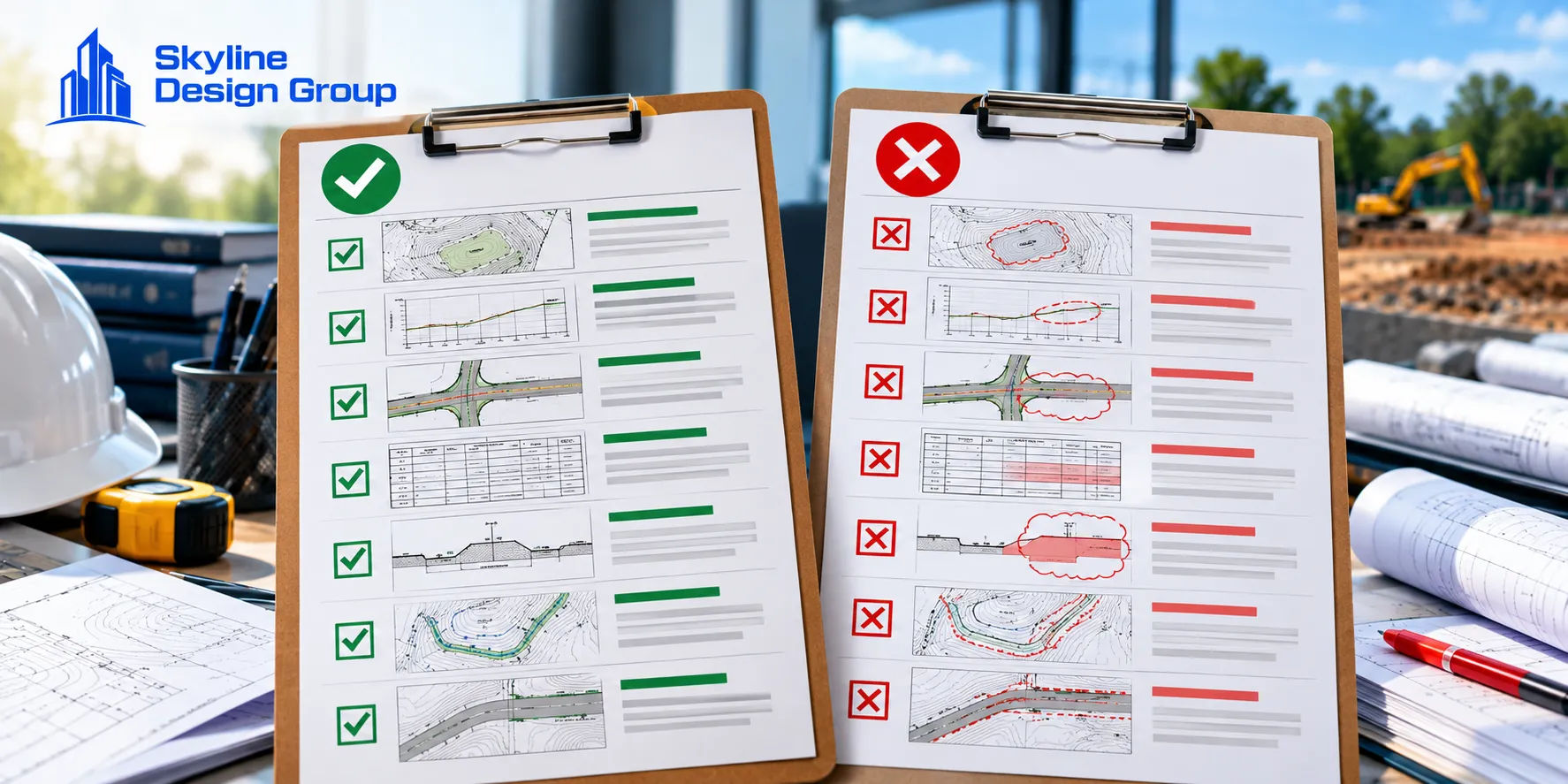
The City of San Jose’s grading and drainage plan review checklist, revised July 16, 2025, and the Town of Queen Creek, Arizona’s grading and drainage plan checklist, dated February 4, 2020, were written for different soil conditions, different flood regimes, and different permit structures, and they still converge on the same four categories of problem. San Jose’s checklist requires 24-by-36-inch sheets, an engineer’s scale shown on every sheet, a complete legend and approval block, and explicitly states that non-compliance with its flagged items “can trigger rejection of submittal.” Queen Creek’s 44-item checklist requires the same sheet size, a utility-coordination block, grade and finish-grade certifications by a registered civil engineer, and a sealed, signed sheet for every page. Neither jurisdiction is unusual; this is standard municipal practice, which is exactly why the same gaps keep showing up across projects in different places.
Category one: sheet and cover-sheet setup
Both checklists front-load their requirements with items that have nothing to do with the grading design itself and everything to do with whether the sheet is reviewable at all: correct sheet size, a scale shown on every sheet, a north arrow, a vicinity map, a legend, project and contact information, and an approval or title block formatted the way the jurisdiction expects. Queen Creek lists wrong sheet size as its first checklist item for a reason; a reviewer who can’t read the plan at the expected scale, or can’t find the contact information, stops there. These items cost nothing to get right and cost a full review cycle to get wrong.
Category two: certifications, seals, and signatures
Queen Creek requires grade and finish-grade certifications from a registered civil engineer and a seal and signature on every sheet; San Jose’s checklist calls for a completed approval block and references the current building code for grading work near structures. A plan that is technically correct but missing a required certification, or sealed on some sheets and not others, reads to a reviewer as incomplete, not as a technical dispute, and gets sent back on that basis alone, regardless of how sound the grading design is underneath it.
Category three: lot-to-lot and boundary grading limits
Queen Creek limits the elevation difference between adjacent lots and requires a retaining wall note if that limit is exceeded; this kind of boundary-condition rule is common across jurisdictions even when the specific number differs. It is also one of the easiest categories to miss in a quick internal check, because the grading on any single lot can look correct in isolation while still creating a boundary condition the plan never addresses. Checking adjacent-lot differentials as their own step, not as a side effect of checking each lot individually, catches this before a reviewer does.
Category four: drainage facility sizing and detail completeness
San Jose’s checklist calls for cut/fill/import/export quantities, overland release paths, and a stated ponding-depth limit; Queen Creek specifies retention basin side-slope and depth limits, a 100-year ponding elevation, and drywell registration and detailing where applicable. These are the items most likely to require an actual design response rather than a drafting fix, which is also why they are the most expensive category to catch late. Confirming that every drainage facility on the plan carries its full required detail set, not just its symbol, is the single highest-value check before a submittal goes out.
| Comment category | What triggers it | How to catch it before submittal |
|---|---|---|
| Sheet and cover setup | Wrong sheet size, missing scale, incomplete title block | Run a formatting-only pass separate from the technical review |
| Certifications and seals | Missing registered-engineer certification, unsealed sheets | Check every sheet, not just the cover, against the seal requirement |
| Lot-to-lot grading limits | Grade difference between adjacent lots exceeds the jurisdiction’s limit | Check boundary conditions as their own step, not per-lot in isolation |
| Drainage facility detail | Incomplete basin sizing, missing ponding elevation or drywell detail | Confirm every facility symbol has its full required detail set attached |
The review-letter example in article 24’s grading plan kickback breakdown shows what one of these categories looks like in a real review letter; the Civil 3D deliverables list in article 27 covers how grading solutions get built in the first place, including where a production team’s QA step fits into catching category one and two issues before they reach a reviewer. If your grading plans keep coming back on the same categories, send us a scope: one drawing set, your standards, and your jurisdiction’s checklist, and we’ll run a formatting and completeness pass before it goes out the door.