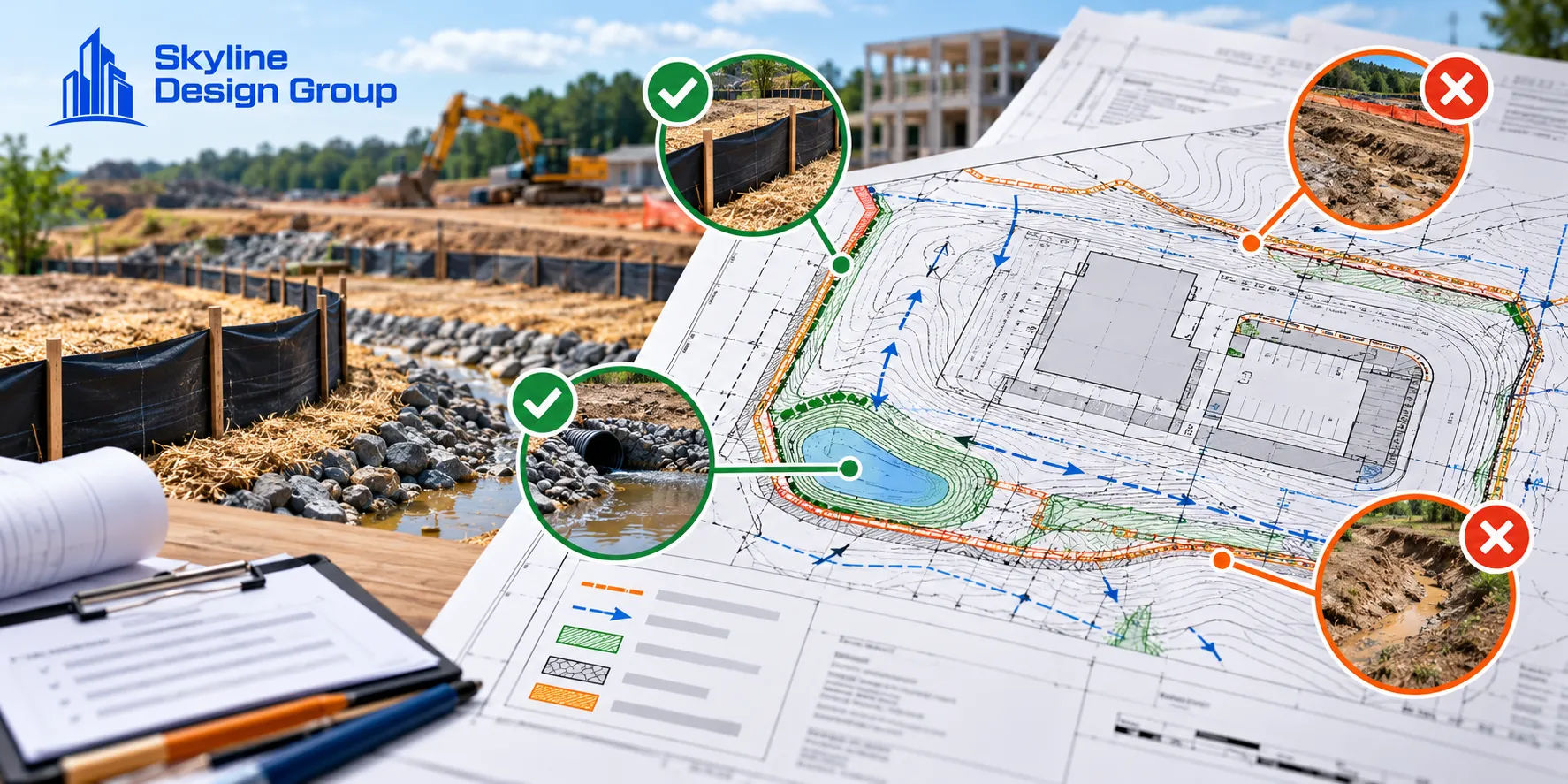
A grading plan can come back from a reviewer three times before anyone notices the erosion and sediment control sheet was never really “designed” by anyone with the authority to sign off on it. Someone drafted it, copied a few standard details from the last project, and hoped the numbers were close enough. On a one-acre infill site that might slide through. On a sensitive-watershed site with a reviewer who reads the narrative closely, it does not.
The confusion is understandable. An erosion and sediment control (ESC) plan looks like a drafting task: symbols, notes, a legend, a table of best-management-practice (BMP) quantities. Most of it is. But the plan also carries engineering judgment and, in many jurisdictions, a credentialed certification that production support cannot provide. Knowing exactly where that line sits is what keeps a project moving and keeps a civil engineer’s stamp meaning what it says.
Production support can draft sheets, place BMP symbols and standard details, build the quantities table, and apply the layout the engineer specifies. It cannot select which BMPs are required, size sediment basins, run soil-loss calculations, or sign the SWPPP certification itself.
Who this is for
This is written for civil engineers and developers who send erosion and sediment control sheets to an outside production team, and who want a straight answer to “can you just handle the ESC plan” instead of a sales pitch. If the job is hydrology modeling, BMP selection, or a stamped SWPPP, that is an engineering or CPESC-credentialed scope, not a drafting scope, and this article says so plainly rather than stretching to claim it.
What an erosion and sediment control plan actually contains
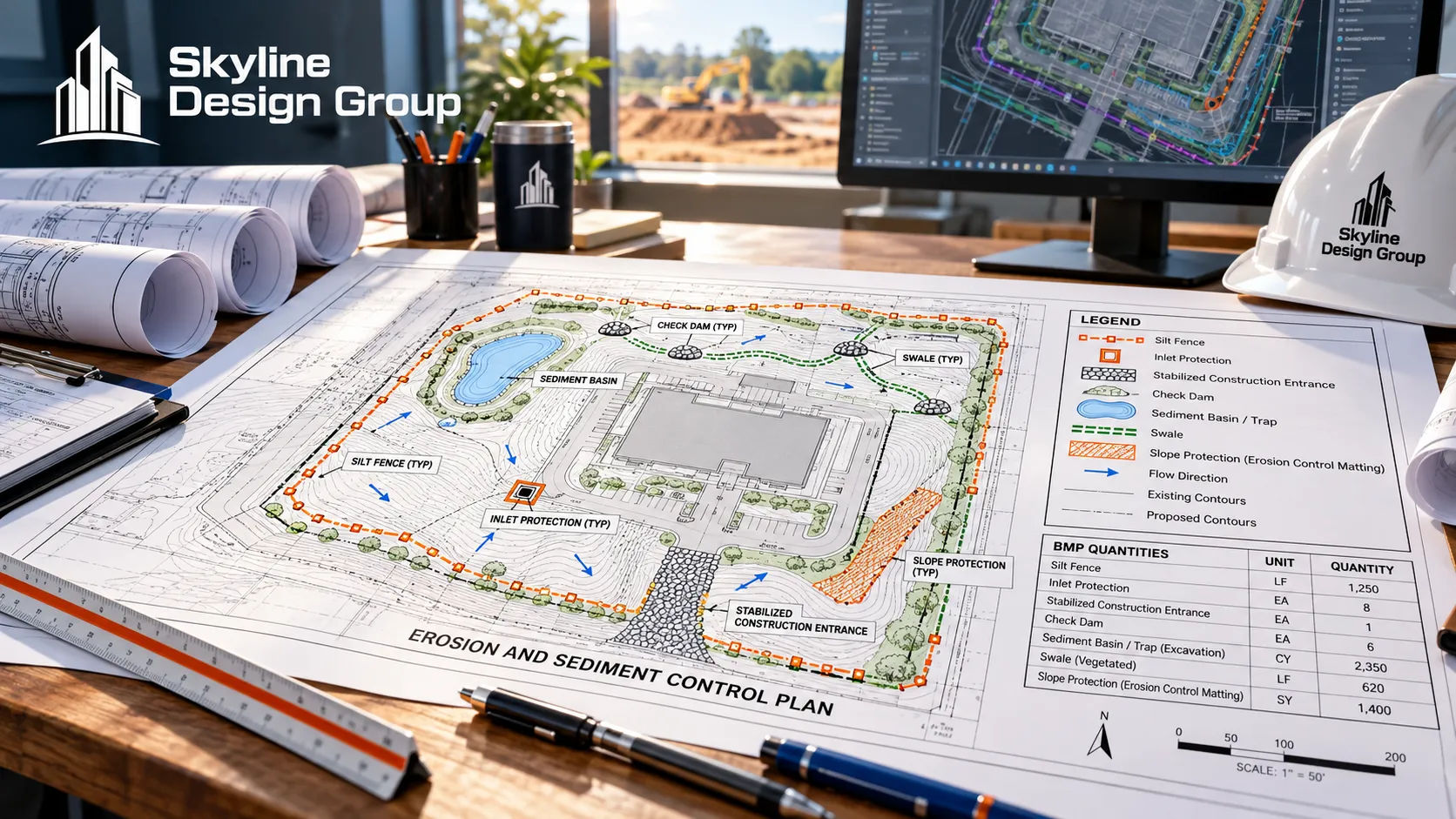
A typical ESC sheet layers several kinds of content on one base plan: the limits of disturbance, existing and proposed contours, the perimeter and inlet protection measures, stabilized construction entrances, sediment basin or trap locations, a phasing note for sites that grade in stages, a legend defining every symbol, and a quantities table converting linear feet of silt fence or square yards of matting into a bid-ready count. Underneath the drafting sits the SWPPP narrative that explains why those specific measures were chosen for that specific site, and the construction general permit (CGP) framework that makes the paperwork mandatory in the first place.
EPA’s draft 2027 Construction General Permit, published for comment on August 3, 2026, keeps that structure in place: permitted sites must install and maintain erosion and sediment controls, pollution prevention measures, and dewatering controls, with the SWPPP developed before the Notice of Intent is filed and kept current afterward. That single requirement is why a plan set that is “mostly right” is not an acceptable deliverable; the SWPPP is a live compliance document, not a one-time drawing.
What production support can decide and draft

Once a civil engineer has specified which BMPs go where, production support earns its keep on the parts that are plainly mechanical: placing the correct standard-detail callouts and symbols at each location the engineer marked; drafting the limits of disturbance and phasing lines from the grading and utility plans already in production; building and formatting the quantities and BMP schedule table; applying the firm’s layer standards, legend, and sheet layout so the ESC sheet matches the rest of the set; and cross-checking that every symbol on the plan has a matching line in the legend and the quantities table, which is a surprisingly common source of reviewer comments on its own. None of that requires a soil-loss calculation. All of it requires someone who reads civil plans fluently and will not quietly change a BMP location to make the drafting cleaner.
What has to stay with the engineer or a CPESC holder
The line sits at anything that decides, rather than records, how the site will actually control erosion. Selecting which BMPs are required for a given soil type, slope, and drainage area; sizing and siting sediment basins, traps, and outlet structures; running runoff or soil-loss estimates such as RUSLE or MUSLE to justify those choices; setting stabilization timeframes for sites discharging to sensitive waters; and signing the SWPPP certification required under the permit all stay on the engineering side of the line. EPA’s own program only recognizes one certification for that signing role: CPESC, the Certified Professional in Erosion and Sediment Control, awarded by EnviroCert International after candidates pass a qualifying exam covering permitting, soil-loss prediction, gross erosion estimation, runoff management, and soil stabilization, and after they commit to a code of ethics and ongoing continuing education. A drafting team, however experienced, is not a substitute for that credential, and a firm that implies otherwise is setting up the engineer of record to defend someone else’s judgment call.
Why the “just handle the ESC plan” request keeps happening anyway
The request usually comes from time pressure, not confusion about roles. A permit submittal deadline is close, the ESC sheet is the last one not finished, and it looks like the fastest fix is to hand the whole thing to whoever is already drafting the grading and utility sheets. The problem shows up later, when a reviewer rejects a BMP selection or a basin size and asks for the calculation behind it, and there is no engineer of record who actually made that call and can answer for it. That round trip costs more time than the delay it was meant to avoid, and it is the exact failure mode a clear scope split is designed to prevent.
The honest fix is sequencing, not refusal: the engineer or CPESC holder makes the BMP and sizing decisions early enough that production support has real time to draft around them, rather than being asked to draft first and justify later. A short transmittal, specifying what has already been decided and what the engineer still owes, below, closes that gap in writing before the deadline becomes the problem.
| What to send production support | What the engineer or CPESC holder still owes |
|---|---|
| Selected BMP types and their marked locations | The calculation or standard justifying each BMP choice |
| Sediment basin size and outlet structure, already sized | Confirmation the sizing meets the governing CGP or local standard |
| Phasing sequence for multi-stage grading | Stabilization timeframes for any sensitive-water discharge |
| Base plan with limits of disturbance and existing contours | The signed SWPPP narrative and certification |
| Firm’s layer standards, legend format, and sheet template | Final technical review of the drafted sheet before submittal |
Erosion and sediment control drafting is one piece of the broader Civil 3D production scope a site engineer can hand off; the next article in this series looks at where that scope extends into corridor and roadway modeling. For a closer look at how the reviewer comments on a related sheet type break down, see the grading plan kickback categories most drafting teams run into.
If your ESC sheets keep getting kicked back for something other than drafting quality, send us a scope: one drawing set, your standards, and a note on what you’d keep in-house, and we’ll tell you plainly what we can take off your plate and what should stay with your engineer.