
5 MEP Coordination Mistakes That Show Up as RFIs Six Weeks Later
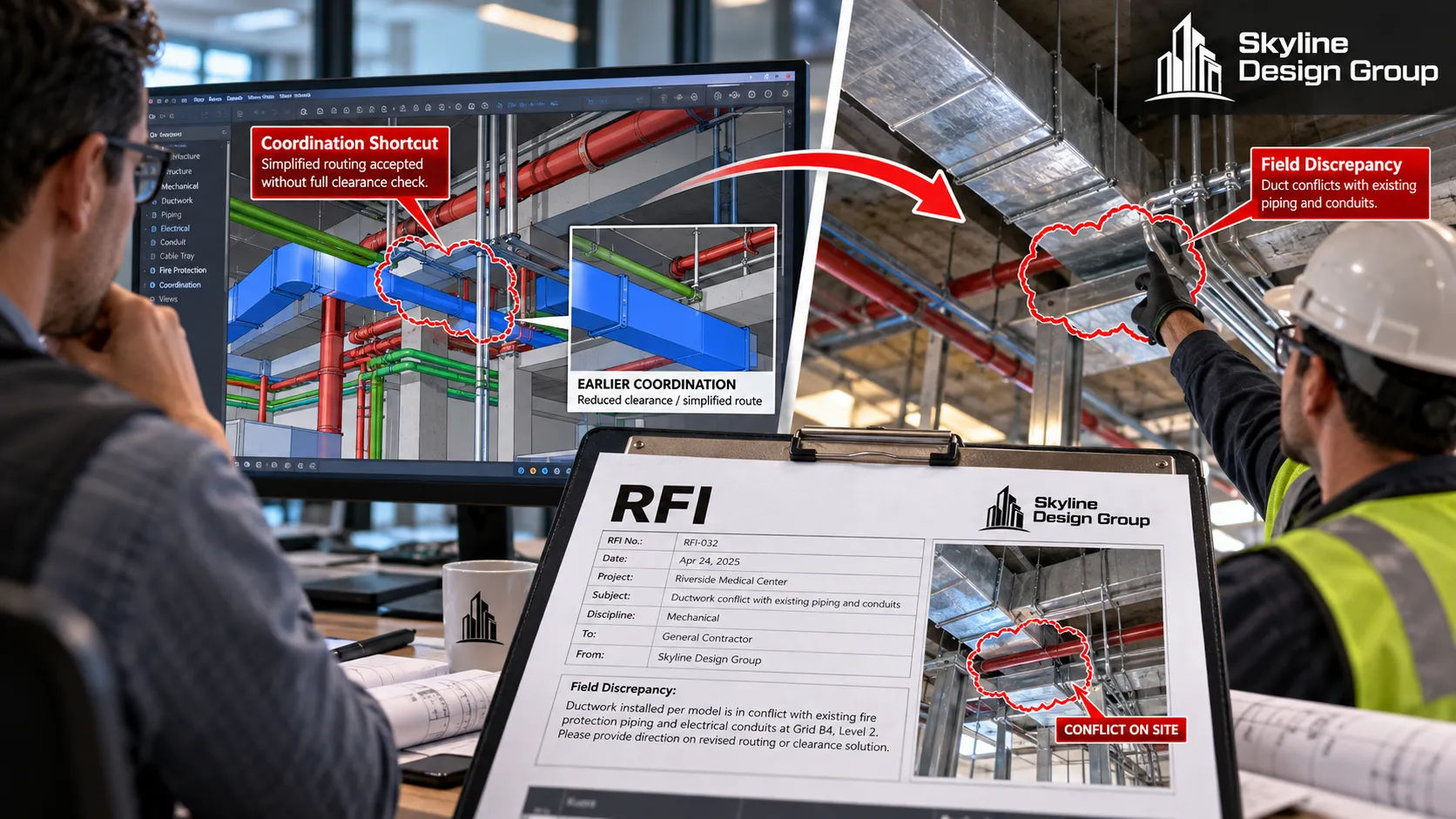
The clash report comes back clean. Everyone moves on. Six weeks later, an RFI lands asking why the as-built conditions don’t match the drawing — and the answer traces back to a coordination shortcut nobody flagged as a problem at the time, because it didn’t look like one.
Research cited in Autodesk’s BIM 360 risk-factor analysis found that less successful construction projects had about 50% more RFIs with a root cause tied to coordination problems than more successful ones — treat that figure as a reported research finding rather than a universal constant, but the pattern behind it holds across the mistakes below: design and coordination information disconnects are a real, trackable driver of downstream RFIs.
The MEP coordination mistakes that turn into RFIs weeks later aren’t dramatic. They’re quiet shortcuts: testing an underdeveloped model, treating “assigned” as “resolved,” fixing a clash without engineering sign-off, letting field documents go stale, or under-reviewing the densest zones. None show up as a clash in the report — they show up later, as a question from the field.
Who this is for
VDC managers and coordination leads who want to know why clean-looking clash reports still generate RFIs weeks after a coordination phase wraps.
Mistake 1: Running the clash test before the model was actually ready
A clash test run against a model that hasn’t reached the level of development the coordination stage needs doesn’t fail loudly — it just produces a shorter, cleaner-looking report, because there wasn’t enough detail in the model to flag the real conflicts yet. That clean report gets treated as a finished coordination pass. The conflicts that were never tested show up later, once the model (or the field) catches up to the detail that was missing.
Mistake 2: Treating “assigned” as “resolved”
A clash gets flagged in a meeting, assigned to a trade, and then nobody checks back until the next session — or the one after that. Without a mid-week follow-up confirming the fix actually happened and was verified, “assigned” quietly becomes the final status by default, even though nothing was ever confirmed closed.
Mistake 3: Resolving a clash without routing it through the engineer of record
Some clash fixes are purely routing — move a conduit, shift a hanger. Others change a pipe size, affect airflow, or touch anything load- or code-related, and those need to go back through the engineer of record before the model gets updated. Skipping that step for the sake of speed creates a model that no longer matches the stamped design, which is exactly the kind of mismatch an inspector or a later reviewer catches — as an RFI, well after the coordination team has moved on.
Mistake 4: Letting field documents go stale after a model change
An isometric or spool drawing issued early in coordination doesn’t automatically update itself when the model changes later. If the field is still installing from the version issued before a late clash resolution, the installed work can end up matching an outdated drawing instead of the current design — a mismatch that often isn’t discovered until someone in the field notices something doesn’t look right and files an RFI to ask why.
Mistake 5: Giving the densest coordination zones the same light review as everything else
Not every part of a model carries equal coordination risk. A podium level, a mechanical room, or a riser stack carrying a dozen units’ worth of systems deserves more review time than a repeated typical floor that has already been confirmed. Spreading review attention evenly across a project, rather than weighting it toward the zones most likely to have real conflicts, means the densest zones get under-reviewed relative to their actual risk — and that is where unresolved conflicts tend to surface later.
Example (illustrative) pattern connecting a mistake to its eventual RFI:
          WEEK 2:  Clash report clean. Model not yet at coordination LOD. [Mistake 1]
          WEEK 3:  Clash C-031 assigned to Electrical. No mid-week check. [Mistake 2]
          WEEK 9:  Rough-in begins using isometric issued in Week 2.
          WEEK 9:  Installed conduit doesn't match current model — RFI filed.
          WEEK 10: Trace-back: C-031 was never actually resolved or re-verified.
Why these mistakes are hard to catch in the moment
What makes this list uncomfortable is that none of the five mistakes look like mistakes when they happen. A clean clash report looks like success. An assigned clash looks handled. A quick routing fix looks like efficiency, not a skipped review step. A drawing issued on schedule looks current, whether or not it still matches the model. And a typical floor that sailed through review looks like proof the process is working, not a sign that attention went somewhere it wasn’t needed most. The RFI six weeks later is often the first real signal that something upstream needs a second look.

Where this fits into a coordination partner’s scope
If RFIs keep tracing back to a coordination phase that looked clean at the time, Request a Scope Review — send a recent RFI log alongside the clash report from the same project and a note on where the two seem to disagree.
For the coordination process these mistakes undermine, see MEP modeling and coordination explained. For the cadence habit that fixes mistake 2 specifically, see resolving MEP clashes without blowing the schedule. For why mistake 3 matters, see MEP coordination vs MEP design.