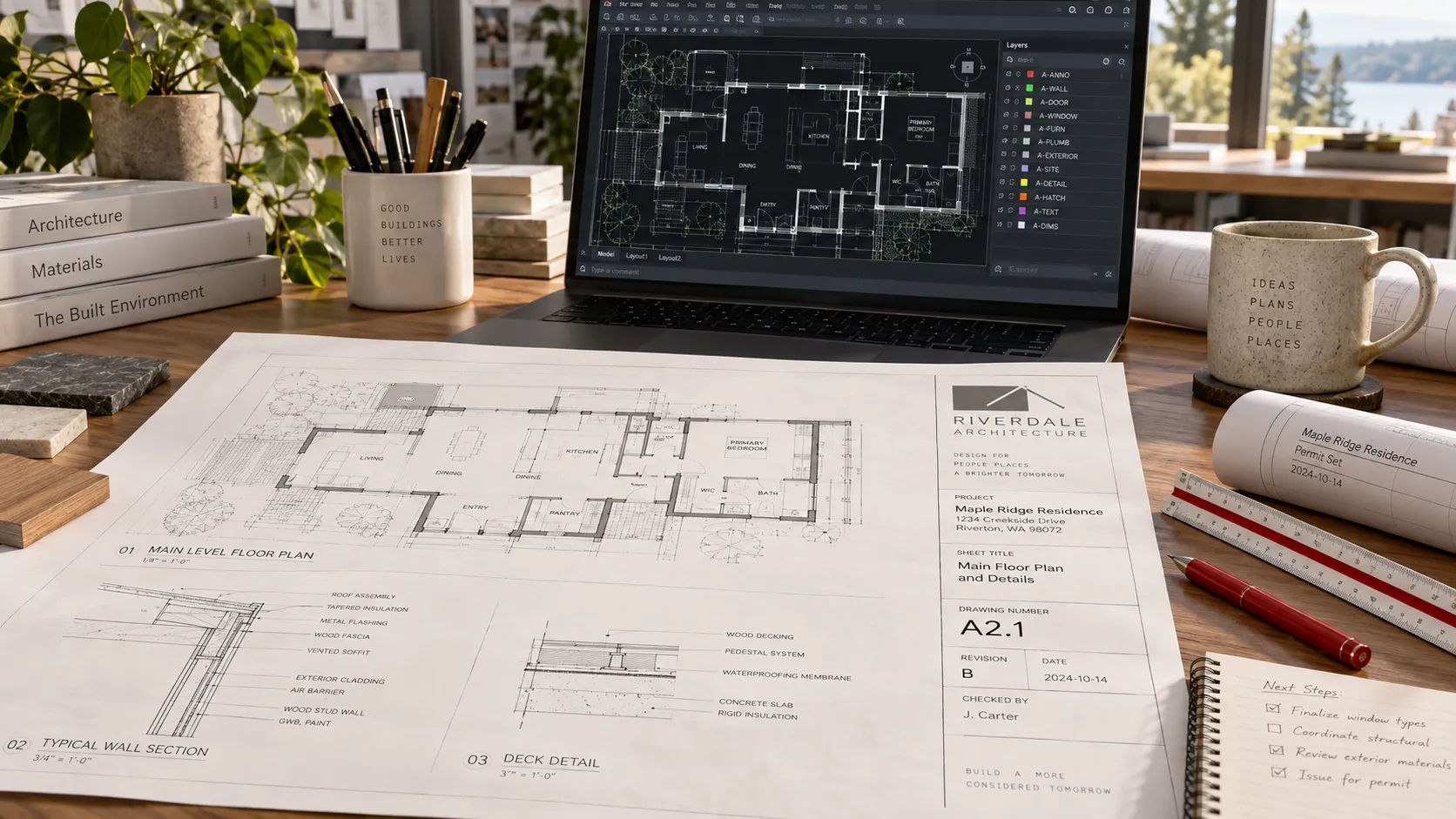
Will my client find out? Every principal who considers white-label drafting asks it in those words. It is the wrong first question.
The better one is: what did we agree in writing?
The short answer: white-label drafting means an outside partner draws the work and it is issued under your firm’s name, with the partner invisible to your client. It needs four things in writing: confidentiality, no contact with your clients, file ownership transferred to you, and a clear statement that seals and design decisions stay with your licensed team.
The word “white-label” is borrowed from products. Here it describes a service: your title block, your standards, your review, and someone else’s drafting hours. It has nothing to do with software, despite what a search for the phrase may return.
This page is for principals at US architecture firms who want extra drafting capacity without putting a client relationship at risk. The advice is general and not legal advice. Have your attorney read the clauses.
What is white-label drafting, and how does it work?
Four steps, and the first one is yours.
- You set the scope and standards. Sheets, formats, title block, layers, naming.
- The partner drafts inside them. Your title block, your layer standard, your file naming. Nothing carries the partner’s brand.
- You review and decide. Every open question comes back to you, not to your client.
- You issue the set under your name, sealed where sealing is required by the licensed professional who controlled the work.
Vendors advertise this openly. Zedtreeo’s page says, in effect, that your name goes on the drawings and that it never contacts or markets to your clients. Whether a vendor says it or not, the arrangement is only as good as what you get in writing.
A partner can adapt to your standards. Skyline’s construction documents page says it works to a client’s title blocks, CAD layers, Revit standards and naming conventions. Working in your title block is the practical core of white-label work.
What rules protect your client relationship?
Nine, and each should have a line in the agreement. Ask your attorney to word them for your state and your contract.
| Rule | Why it matters | Put in writing |
|---|---|---|
| Confidentiality | Your files show your client’s project | An NDA that covers your files and your client’s identity, signed before files move |
| No contact | A stray email from the partner to your client ends the arrangement | The partner does not contact or market to your clients, and directs every question to you |
| No solicitation | A partner who knows your clients may be tempted | A limited-time restriction on soliciting your clients for the same work; your attorney sets scope and length |
| No onward sharing | Your files should not travel | The partner does not pass your files to another party without your written consent |
| File ownership | Ownership does not transfer on its own | A written assignment of the drawings to you (see below) |
| Clean files | Working files can carry the partner’s name | You check file properties, title blocks, xref paths, file names and PDF details before issue |
| One channel | Two voices confuse a client | All client-facing communication goes through you |
| Seals and decisions stay yours | The seal stands behind your control of the work | A scope that says design, code and seal decisions are yours |
| A clean exit | You may want to leave | Files returned in agreed formats; the partner keeps nothing you did not approve |
Two of these need a little more explanation.
File ownership. Under US copyright law, work by an independent contractor is a “work made for hire” only if it falls in one of nine listed categories and both sides sign a written agreement saying so (U.S. Copyright Office, Circular 30). Technical drawings are not named on that list. So do not assume the drawings become yours because you paid for them. Get a written assignment.
Clean files. A file can say who made it. AutoCAD keeps drawing properties, including Author and custom fields, in DWGPROPS, according to Autodesk community experts. Title blocks, xref paths, layer names and file names can also give a partner away. Check them before a set goes out.
Do you have to tell your client?
It depends on your contract, and on any confidentiality terms with the owner. Read them. Some agreements say who may do the work. Some are silent. If yours requires disclosure, follow it.
White-label is a branding arrangement. It is not a way around your obligations to your client or to your licensing board. The responsible control idea in NCARB’s Model Law still applies: the licensed professional needs authority over the design and technical decisions and the knowledge to oversee the work that others do on their behalf. The details, and how they interact with sealing, are in who stamps the drawings.
If you are not sure, ask your attorney. Do not guess, and do not decide it under deadline.
Example (illustrative). An invented scenario, not a client project. A partner’s drafter is missing a door schedule detail. Rather than ask the firm, the drafter emails the owner’s project manager, who has never heard of the partner. The owner now knows the work is outside the office. Worse, the answer comes from the owner’s side, not from the architect. A no-contact clause and a one-channel rule would have sent the question to the firm instead, and the firm would have answered it before anyone else did.
What can go wrong?
Most failures come from the gap between what was assumed and what was written.
- Metadata slips. A file property or xref path names the partner. Scrub before issue, and ask the partner to work from a clean template.
- A partner lists your project as a reference. Cover this in the NDA. Confidential means your name and your client’s too.
- Files go to a third party. Ask whether the partner uses subcontractors, and require consent.
- Ownership is assumed, not assigned. You may not own what you paid for.
- Shared workspaces. Invites to review portals and file-sharing sites can expose partner and client emails to each other. Set the permissions before you invite anyone.
- Blurry decisions. If the partner is guessing design questions, you are losing control of the work. A partner that flags gaps instead of assuming, as Skyline’s redline process says it does, sends the decision back to you.
None of this means you should avoid white-label work. It means writing it down, and writing it before the first file moves. The twelve questions to ask a drafting partner is a good place to start that conversation.
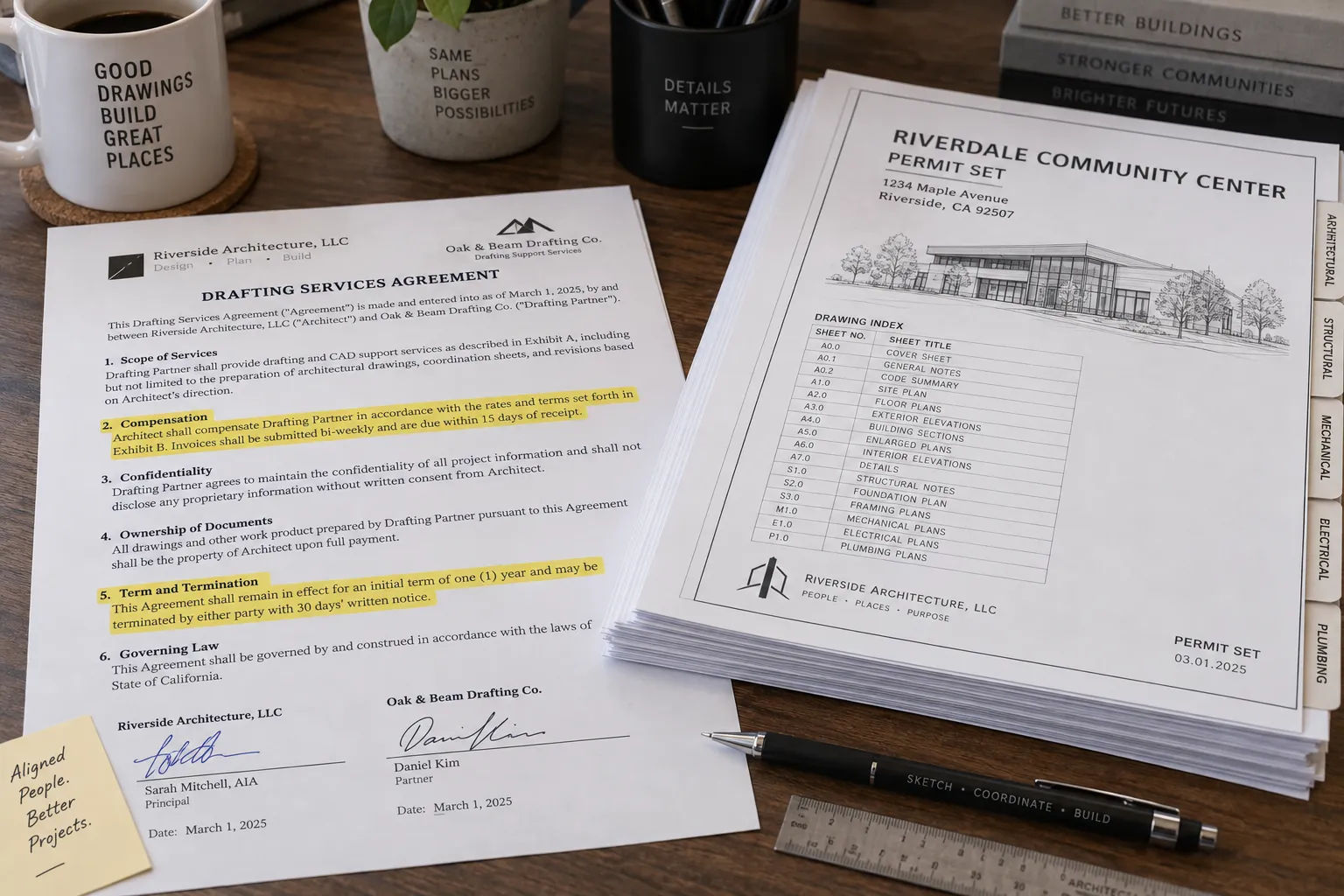
Ask before you hand off
If white-label work is on your list, put these rules to any partner you are considering, Skyline included. To start with Skyline, you can request a scope review: send one drawing set, your standards and a note on what you would keep in your own office. Skyline drafts to your standards and leaves design decisions, code determinations and seals with your licensed team.
Sources
- Works Made for Hire, Circular 30, U.S. Copyright Office (revised August 2024)
- NCARB Model Law and Model Regulations, National Council of Architectural Registration Boards
- Architectural drafting services, Zedtreeo (white-label and no-contact statements; no page date)
- DWG Author or Creator information, Autodesk Community (DWGPROPS Author and custom properties)
- Skyline Design Group: construction documents and redline conversions. Checked 2026-09-21.

