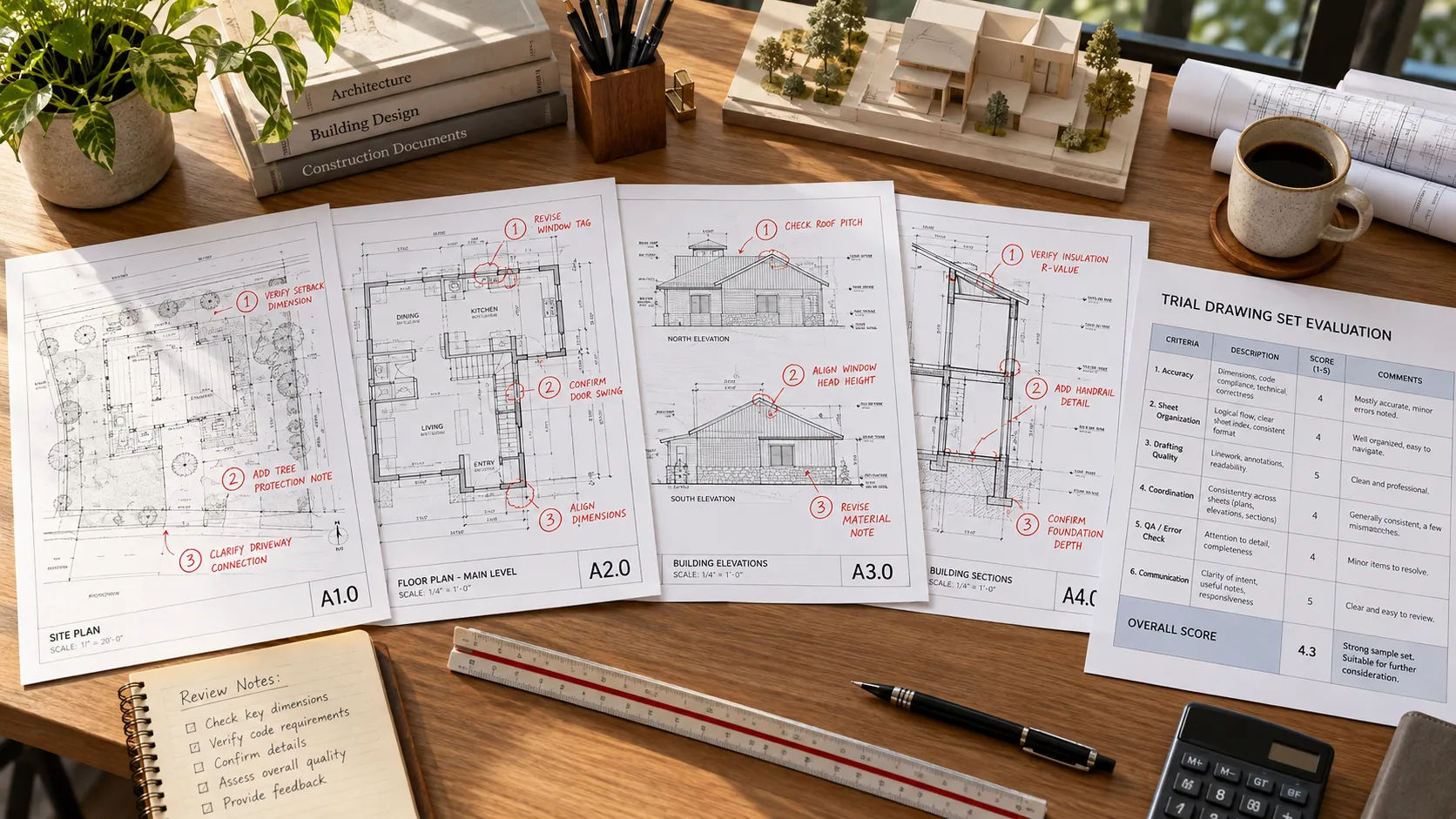
The worst way to test a drafting partner is with your easiest sheet. It will pass. And you will have learned nothing.
A useful trial is built to fail in small, visible ways. That is how you find out what the partner does when it does not know the answer.
The short answer: to test a drafting partner, send one small, real set of three to six sheets that includes a messy markup, a schedule and a section, with your standards attached. Grade the return on six things: standards match, accuracy against the markups, flagged questions, the revision log, response time and your own review hours.
This page is for principals and project architects who are about to hand outside drafting to a new partner and want evidence before they commit a project. It gives you the set to build, the pack to send and a scorecard you can copy.
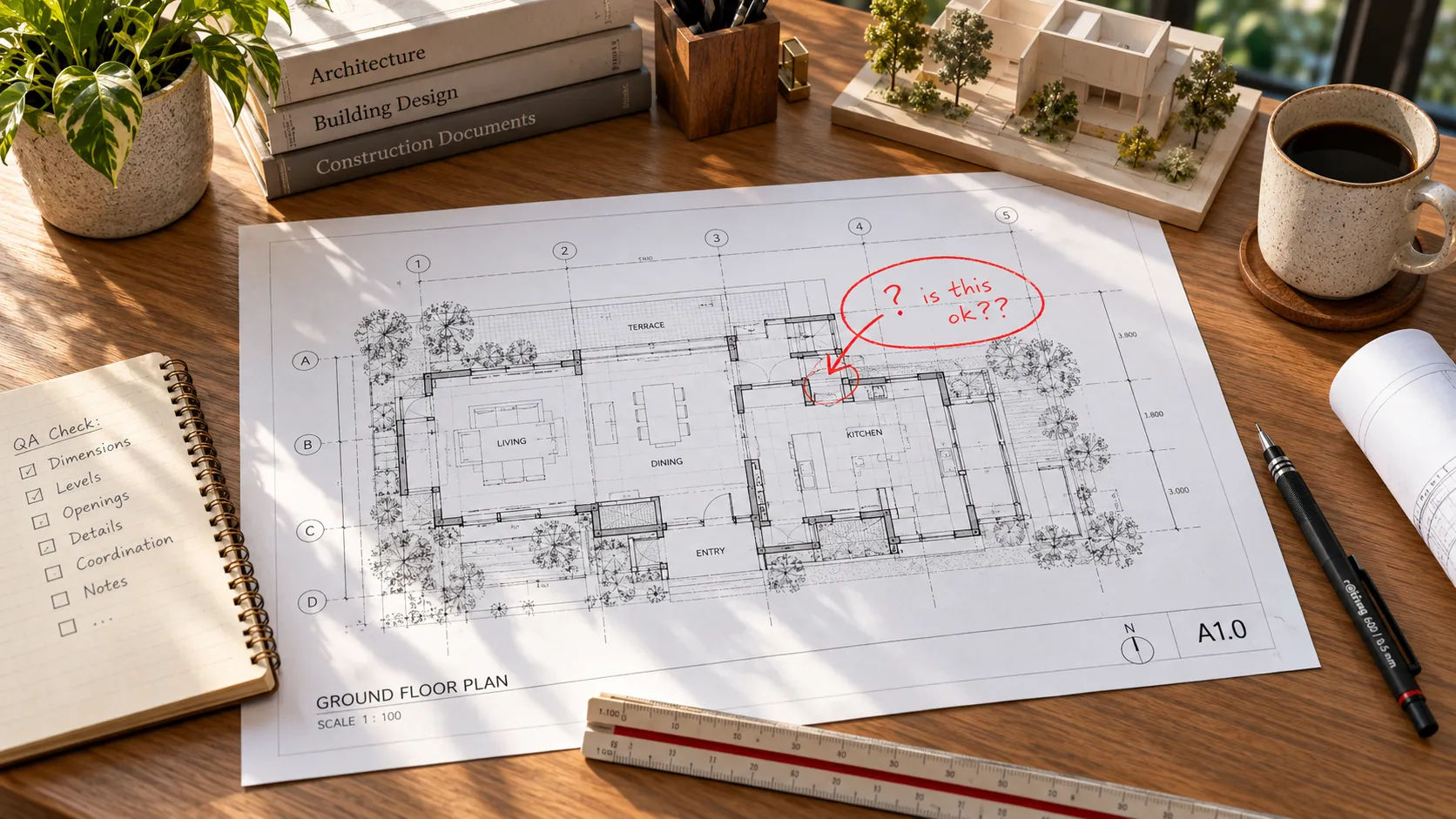
How do you test a drafting partner with one drawing set?
Start by choosing the set. It should be real, small and slightly awkward.
- Real. A trial on a made-up project tests nothing. Use a live project’s sheets, under an NDA, or redact them.
- Small. Three to six sheets. Big enough to show habits, small enough to grade in an afternoon.
- Not on the critical path. Pick sheets you can afford to have wrong.
- With an answer key. Know what the right result looks like before the set goes out. Mark it up yourself, or have someone in your office draw the sheets.
Then build the traps in. Not to trick the partner, but to see how it behaves on the day it will matter.
| Include in the set | What it tests |
|---|---|
| One markup that is unclear or incomplete | Does the partner flag it, or guess? |
| Two dimensions that conflict between a plan and a section | Cross-sheet checking |
| A door or window schedule tied to plan tags | Tags, references and data consistency |
| A section or detail with callouts to other sheets | Cross-references |
| A consultant background with a small conflict | Coordination and whether conflicts get reported |
| Your title block, layer standard and naming rule | Whether the partner works in your standards |
If you send only clean, clear markups, you will get clean, clear results and no information.
What should you send with the trial set?
Send it the way you would send a real job. Otherwise the trial only tests the trial.
- Your standards. Title block, layer or Revit standard, naming, sheet numbering. If nothing is written down, the US National CAD Standard from the National Institute of Building Sciences, with its Uniform Drawing System and AIA CAD Layer Guidelines, is a published baseline.
- The files and the markups. Numbered, dated, one instruction per markup.
- A one-page scope note. What is in, what is out, and the rule that unclear items get flagged, not fixed. The handoff note in the outsourcing guide is one you can copy.
- A named person and a due date. One contact on each side.
- A midpoint check. AEC Associates, a drafting vendor, recommends a checkpoint at about 50 percent of the work and documented acceptance criteria before production begins. Both are cheap to add.
And agree one thing in writing before you start: who does the work. Ask whether the people on the trial are the people who will do the real job.
How do you grade the result?
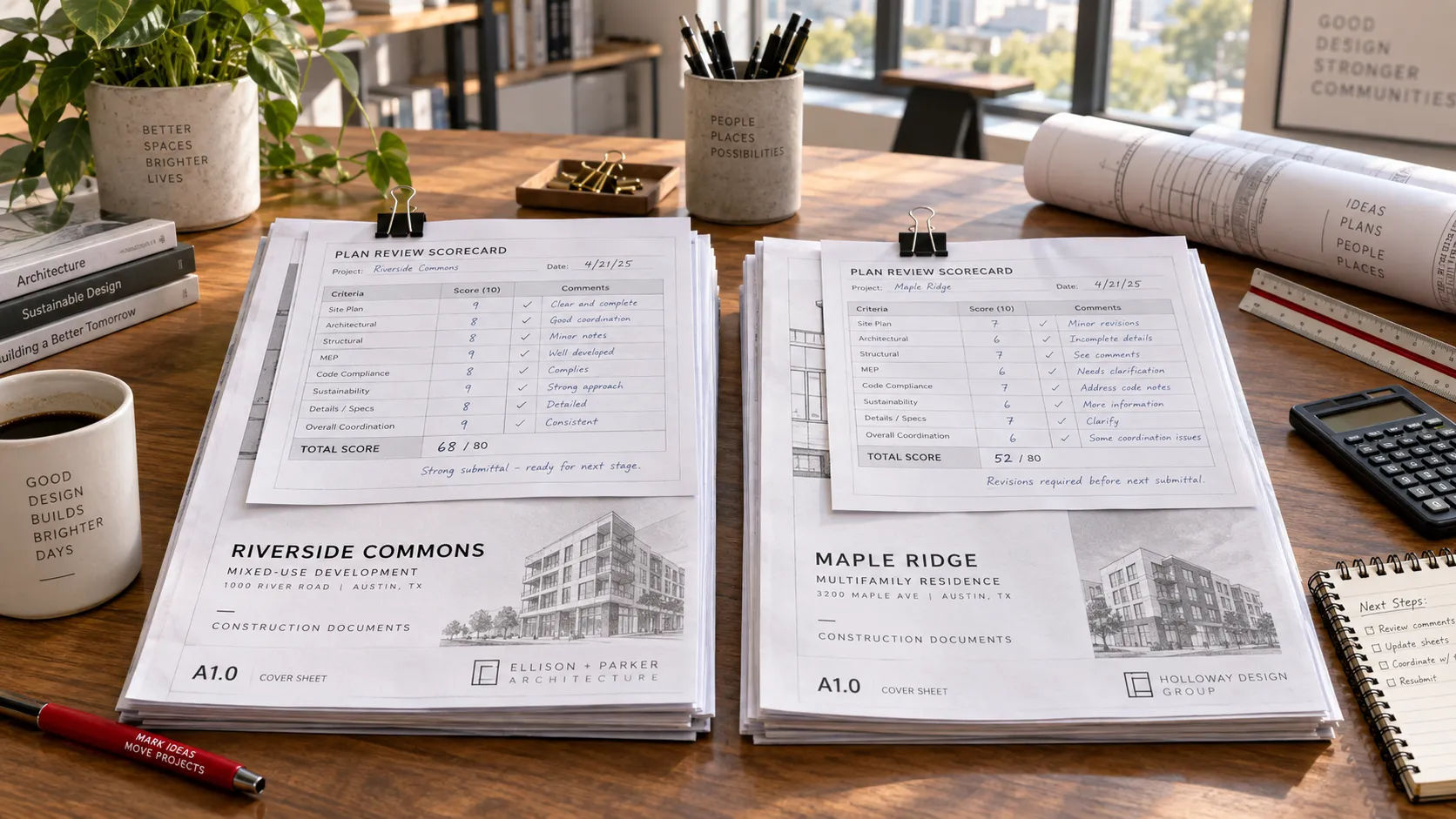
Grade against a fixed scorecard, not a feeling. The AIA’s guidance on quality control for working drawings gives the yardstick: drawings should be accurate and coordinated, dimensions and details correct, everything neat, legible and properly cross-referenced, and symbols and abbreviations explained (AIA, Quality control: Preparation of working drawings). It also says the review should be done by a qualified person who was not involved in preparing the documents. That person should be you or someone in your office, not the partner grading itself.
The hour bands on line 8 are placeholders. Set them from what your own team can afford to spend on a small set. And the total thresholds are a starting point, not a standard.
Example (illustrative). Invented scores to show how the card works. Two partners get the same four-sheet set. Partner A’s set looks a little rough. But it comes back with three written questions, a revision log that matches all 38 markups, and five small errors. Score: 14 of 16. Partner B’s set looks cleaner. It has no questions, and two markups were quietly misread. Score: 9 of 16, with a hard fail for the unflagged guesses. B was faster and prettier. A is the one you hire.
What does a trial cost, and how long should it take?
Less than a wrong partner. Some vendors offer the first drawing free. Zedtreeo’s page says it does one complimentary drawing with no obligation, for example. Others charge a small fee for a pilot. Either is reasonable. Free is not better if you cannot get a real set graded.
Skyline’s homepage invites you to test its precision on your next drawing set. Whatever the arrangement, agree the turnaround in writing before the files move.
Do not forget your own time. Log the real hours for line 8, and put them into the in-house vs outsourced cost model to get a real number for management time.
What can a trial not tell you?
Some things only show up at volume.
- Consistency over months. One good set is one good set.
- Behavior on revision round three. Trials rarely test the fourth change to the same sheet.
- Who does the real work. A partner may put its best people on the trial. Ask, and ask again at the first real job.
- Capacity in a crunch. You will not learn what happens when you send twelve sets in a week.
The AEC Associates article makes a related point: QA that happens only at handoff, with no milestones, is a common reason outsourced CAD work fails mid-project. So build a checkpoint into the real job as well.
Send one set
That is the whole method, and it matches how Skyline invites you to start. You can request a scope review: send one drawing set, your standards and a note on what you would keep in your own office. Skyline drafts to your standards in AutoCAD, Civil 3D or Revit, and leaves design decisions, code determinations and seals with your licensed team. Its redline conversion service lists the inputs it works from, which makes a good checklist for what to put in the pack.
Sources
- Quality control: Preparation of working drawings, American Institute of Architects Resource Center (contributed November 30, 2023)
- United States National CAD Standard, Version 7, National Institute of Building Sciences
- Why outsourced CAD production fails mid-project, The AEC Associates (August 25, 2026; a drafting vendor)
- Architectural drafting services, Zedtreeo (one complimentary drawing; no page date)
- Skyline Design Group: redline conversions and the homepage. Checked 2026-09-21.

